


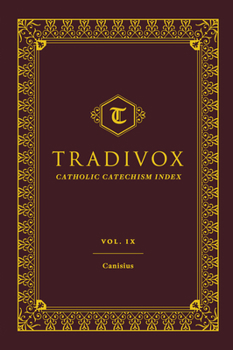
Tradivox Vol 9: Canisius
(Book #9 in the Tradivox Catholic Catechism Index Series)

The two catechisms contained in Volume 9 are perhaps the greatest of the Catholic Reformation period, the work of the great catechist and doctor of the Church, St. Peter Canisius.
After successfully establishing the first Jesuit house in Germany (despite the increasingly heretical teachings of the local archbishop), the emperor Ferdinand I besought Canisius to create a catechism that could serve the needs of both priests and laity, with the same gentle charity and precision that marked all of Canisius preaching and teaching in an age of great confusion and distress. The result of the Saint's efforts was a catechism in three different iterations: the landmark Summa Doctrina Christianae or "Large Catechism" (1555), which was a compendious and impressively annotated work intended for priests and scholars; the tiny and less popular 1556 synopsis known as Catechismus Minimus; and finally, the Catechismus Minor or "Small Catechism" (1558), which became so widely influential as to be known simply as "the Canisius." The great Saint Robert Bellarmine, having published his own catechism, admitted that if he had been aware of Canisius work at the time, he "would not have put so much effort into writing a new catechism. I would then have simply translated Peter Canisius's catechism "
For the first time, both the Large and Small versions of Canisius superb work are reproduced together in this volume, taken from English translations carried by the underground Catholic press during the Elizabeth era. Appearing during major technical advances in printing, Canisius's catechism quickly became one of the first international bestsellers, with no fewer than three hundred editions appearing during the author's lifetime, and innumerable editions and translations after his death.
Customer Reviews
ThriftBooks® and the ThriftBooks® logo are registered trademarks of Thrift Books Global, LLC
