


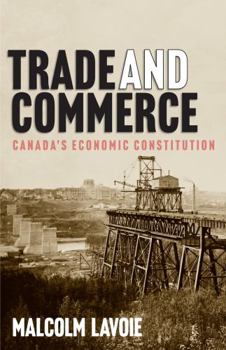
Trade and Commerce: Canada's Economic Constitution Volume 261
No Customer Reviews

In recent decades, the economic framework of Canada's Constitution has been a subject largely neglected by judges, scholars, and commentators. Trade and Commerce fills this gap by bringing to light a lost understanding of how the Constitution structures economic relations.As Malcolm Lavoie reveals, the Constitution includes foundational commitments to property rights, local government autonomy, and the principle of subsidiarity. At the same time, it creates a platform for integrated national markets with secure channels for interprovincial trade. This economic vision remains a vital part of Canada's constitutional order and is relevant to a purposive interpretation of the Constitution. But contemporary legal discourse has begun to lose touch with this vision, with regrettable consequences in a number of different policy areas.Exploring the implications of the economic Constitution in the context of contemporary issues - including disputes over interprovincial trade and jurisdictional tensions between federal, provincial, and Indigenous governments with respect to the environment and the economy - Trade and Commerce restores economic ideas to the forefront of constitutional thinking in Canada.
Format:Hardcover
Language:English
ISBN:0228016460
ISBN13:9780228016465
Release Date:February 2023
Publisher:McGill-Queen's University Press
Length:272 Pages
Weight:1.28 lbs.
Dimensions:1.0" x 6.1" x 9.1"
Customer Reviews
0 rating
Copyright © 2026 Thriftbooks.com Terms of Use
| Privacy Policy | Do Not
Sell/Share My Personal Information | Cookie Policy | Cookie Preferences | Accessibility Statement
ThriftBooks® and the ThriftBooks® logo are registered trademarks of Thrift Books Global, LLC
ThriftBooks® and the ThriftBooks® logo are registered trademarks of Thrift Books Global, LLC
