


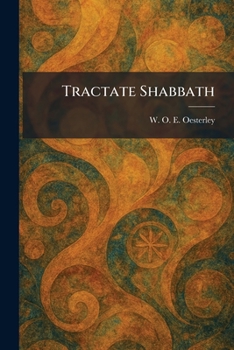
Tractate Shabbath

Select Format
Select Condition 
Book Overview
"Tractate Shabbath" is a fundamental work of Jewish legal scholarship, focusing on the intricate laws and traditions governing the Sabbath as outlined in the Mishnah. This treatise provides an exhaustive examination of the thirty-nine categories of work prohibited on the holy day, offering deep insight into the spiritual and practical foundations of Jewish life. Translated and annotated by the distinguished scholar W. O. E. Oesterley, this volume bridges the gap between ancient rabbinic tradition and modern academic study.
The text explores the complex definitions of labor, the boundaries of domestic and public space, and the specific rituals that distinguish the Sabbath as a day of rest and sanctification. Oesterley's scholarly commentary provides historical context and linguistic analysis, making the text accessible to students of theology, history, and comparative religion. As a significant portion of the Seder Moed, "Tractate Shabbath" remains a cornerstone for understanding the development of Halakhic law and the enduring legacy of the Talmudic period. This work serves as an essential resource for those seeking to understand the religious evolution of the Jewish faith and the meticulous devotion associated with the observance of the Sabbath.
This work has been selected by scholars as being culturally important, and is part of the knowledge base of civilization as we know it. This work was reproduced from the original artifact, and remains as true to the original work as possible. Therefore, you may see the original copyright references, library stamps (as most of these works have been housed in our most important libraries around the world), and other notations in the work.
This work is in the public domain in the United States of America, and possibly other nations. Within the United States, you may freely copy and distribute this work, as no entity (individual or corporate) has a copyright on the body of the work.
As a reproduction of a historical artifact, this work may contain missing or blurred pages, poor pictures, errant marks, etc. Scholars believe, and we concur, that this work is important enough to be preserved, reproduced, and made generally available to the public. We appreciate your support of the preservation process, and thank you for being an important part of keeping this knowledge alive and relevant.
Customer Reviews
ThriftBooks ® and the ThriftBooks ® logo are registered trademarks of Thrift Books Global, LLC
