


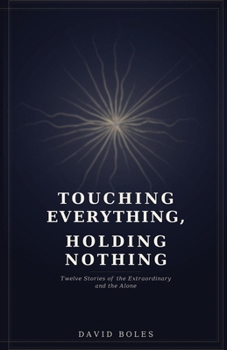
Touching Everything, Holding Nothing: Twelve Stories of the Extraordinary and the Alone

Twelve characters. Twelve gifts that function as sentences.
An old man can only speak in limericks. A dragon kitten burns too hot and too wrong for its own kind. A postal rider crosses frozen wilderness carrying other people's connections while having none of his own. A boy cannot stop climbing. A physicist discovers he can fold spacetime but cannot close the distance to his own kitchen table. A medieval dyer transmutes matter with her hands and watches her neighbors recoil from the miracle. A teenager becomes a walking nuclear reactor who can save cities but cannot embrace another person. An archivist remembers everything and learns that perfect recall is a form of solitary confinement. A detective in 1920s New York watches his obsessive pursuit of justice corrode into the very corruption he set out to destroy. A ship's doctor navigates a catastrophe in the Drake Passage where every decision about who lives becomes a verdict about who matters. A billionaire ascends to an impregnable mountaintop fortress and discovers that the burial began the moment he stopped hearing human voices. A spy masters the art of invisibility and then spends years trying to become ordinary enough to be seen.
Each protagonist reaches the world in some remarkable way and finds that the reach itself prevents the grasp. They affect everything around them and possess nothing of what they most need: ordinary human closeness, the unremarkable warmth of being known without being studied, feared, worshipped, or fled from.
These stories were written across genres because isolation does not respect genre. It operates in comedy and tragedy, in medieval fantasy and 1920s noir, in speculative physics and maritime disaster, in myth and espionage. The variety of settings is deliberate. The sameness of the central ache is the point.
Customer Reviews
ThriftBooks ® and the ThriftBooks ® logo are registered trademarks of Thrift Books Global, LLC
