


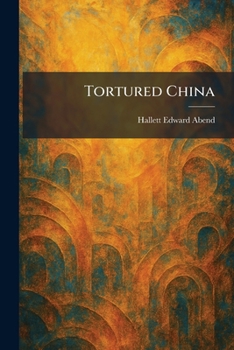
Tortured China

Select Format
Select Condition 
Book Overview
"Tortured China" provides a searing and firsthand account of the political and social upheaval that gripped the Chinese nation during the early 20th century. Written by Hallett Abend, a prominent correspondent for the New York Times, this work offers a detailed examination of a country fractured by internal strife, warlordism, and the complex interplay of foreign interests. Abend delves into the profound suffering of the Chinese populace as they navigated the transition from imperial rule to a fragmented republic, highlighting the chaos of civil conflicts and the struggle for national unification.
The narrative captures a pivotal moment in global history, illustrating the challenges of modernization amidst deep-seated cultural traditions and mounting external pressures. Through acute observations and journalistic rigor, the book explores the humanitarian crises, economic instability, and the rise of revolutionary movements that would eventually reshape the geopolitical landscape of Asia. "Tortured China" serves as a significant historical document, reflecting the perspectives of a Western observer witnessing the birth pains of a modern nation. It remains a valuable resource for those interested in the history of international relations, Asian studies, and the enduring impact of political instability on human lives.
This work has been selected by scholars as being culturally important, and is part of the knowledge base of civilization as we know it. This work was reproduced from the original artifact, and remains as true to the original work as possible. Therefore, you may see the original copyright references, library stamps (as most of these works have been housed in our most important libraries around the world), and other notations in the work.
This work is in the public domain in the United States of America, and possibly other nations. Within the United States, you may freely copy and distribute this work, as no entity (individual or corporate) has a copyright on the body of the work.
As a reproduction of a historical artifact, this work may contain missing or blurred pages, poor pictures, errant marks, etc. Scholars believe, and we concur, that this work is important enough to be preserved, reproduced, and made generally available to the public. We appreciate your support of the preservation process, and thank you for being an important part of keeping this knowledge alive and relevant.
Customer Reviews
ThriftBooks ® and the ThriftBooks ® logo are registered trademarks of Thrift Books Global, LLC
