


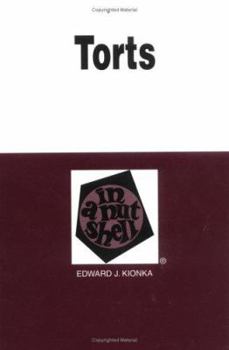
Torts in a Nutshell

Select Format
Select Condition 
Book Overview
A clear, concise, current, and authoritative explanation of all of the most important U.S. tort law doctrines, including those covered in first-year torts courses in law schools. Coverage includes... This description may be from another edition of this product.
Format:Paperback
Language:English
ISBN:0314235256
ISBN13:9780314235251
Release Date:June 1999
Publisher:West Group
Length:513 Pages
Weight:1.10 lbs.
Dimensions:7.5" x 1.0" x 5.0"
Related Subjects
Business Civil Procedure Education & Reference Law Rules & Procedures Textbooks TortsCustomer Reviews
1 rating
Torts by Kionka
Published by Thriftbooks.com User , 22 years ago
The fundamental rationale of torts admits to the fact that someone has been harmed. The common law developed a tort froma group of wrongs including trespass, deceit, slander, assault and battery convergence and a number of other offenses. The mainstay claim is that someone has sustained a loss because of another's act or failure to act. Therefore, a common element oftort liability is fault. The tortious conduct must fall below an accepted community threshold or standard of behavior/performance.Tort law has three main functions. It seeks compensation to theperson(s) incurring a loss as a result of another's conduct.It places the cost of compensation on those who should bear responsibility. The ultimate goal is to prevent a future recurrence/harm. In its simplest form, cause in fact is established by evidence which tends to show that the defendant's act or omission was a necessary antecedent to the plaintiff'sinjury. Generally, a jury need only draw a reasonable inferenceof causation so that its determination is final.The work has a generous coverage of the origins of torts,causation, strict liability, liability for negligent conduct,intentional misconduct, defenses, special liability rules,damages for physical harm and immunities. The work is a worthypurchase for a wide constituency of users in government, lawand academe.
Copyright © 2026 Thriftbooks.com
Terms of Use | Privacy Policy | Do Not Sell/Share My Personal Information | Cookie Policy | Cookie Preferences | Accessibility Statement
ThriftBooks ® and the ThriftBooks ® logo are registered trademarks of Thrift Books Global, LLC
ThriftBooks ® and the ThriftBooks ® logo are registered trademarks of Thrift Books Global, LLC
