


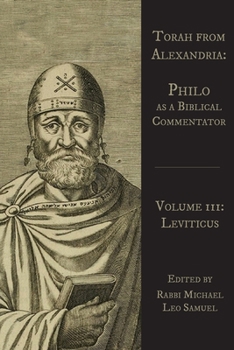
Torah from Alexandria: Philo as a Biblical Commentator (Leviticus)
No Customer Reviews

The third volume of Torah from Alexandria sets on display how Philo interpreted the role of the Temple, offerings, festivals, dietary practices, marital laws, and laws of purity. While Philo always remains firmly committed to the importance of the actual religious act, he consistently derives ethical lessons from these ritual practices, thus putting him alongside the great Jewish philosophers of history. Reading Philo alongside Rabbinic wisdom, Greek philosophy, Patristic writers, as well as Medieval and modern authors, breathes new life into the complexities of Leviticus and reinstates Philo's importance as a biblical exegete.Reclaiming Philo as a Jewish exegete puts him in company with the great luminaries of Jewish history-a position that Philo richly deserves. Philo remains as one of Jewish history's most articulate spokespersons for ethical monotheism. Rabbi Michael Leo Samuel has meticulously culled from all of Philo's exegetical comments, and arranged them according to the biblical verses. He provides extensive parallels from rabbinic literature, Greek philosophy, and Christian theology, to present Philo's writing in the context of his time, while also demonstrating Philo's unique method of interpretation.
Format:Paperback
Language:English
ISBN:0692415440
ISBN13:9780692415443
Release Date:April 2015
Publisher:Kodesh Press
Length:286 Pages
Weight:0.93 lbs.
Dimensions:0.6" x 6.0" x 9.0"
Customer Reviews
0 rating
Copyright © 2026 Thriftbooks.com Terms of Use
| Privacy Policy | Do Not
Sell/Share My Personal Information | Cookie Policy | Cookie Preferences | Accessibility Statement
ThriftBooks® and the ThriftBooks® logo are registered trademarks of Thrift Books Global, LLC
ThriftBooks® and the ThriftBooks® logo are registered trademarks of Thrift Books Global, LLC
