


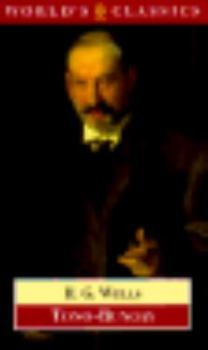
Tono-Bungay


Select Format
Select Condition 
Book Overview
Tono-Bungay (1909) is widely regarded as Wells's finest novel, combining futuristic science fiction and contemporary social satire. In it, George Ponderovo is apprenticed to his Uncle Edward, a dynamic chemist who invents a bogus medicine, Tono-Bungay, and earns a vast fortune. But as he witnesses Edward's spectacular rise, he also contemplates the corrupt English society that allows his uncle to wield so much power. No other writer has the breadth of Wells to encompass both George's personal breakdown and the full panorama of a degenerate imperial society.
Format:Paperback
Language:English
ISBN:0192828290
ISBN13:9780192828293
Release Date:March 1997
Publisher:Oxford University Press, USA
Length:480 Pages
Weight:0.58 lbs.
Dimensions:0.8" x 4.5" x 7.3"
Customer Reviews
3 ratings
The Wells you should know
Published by Thriftbooks.com User , 19 years ago
This book is completely modern, maybe because Wells always seemed to have one foot in the future and one in the past. He had a good feel for the scope of history past and history to be made. But it should also be pointed out what a fine writer and stylist Wells was. The book is beautifully written. The prose flows. I always loved this about his works of Science Fiction, the ones most people know about, but it is even more apparent in this mature work of literature. Read Tono Bungay for the music of his words, as well as the truth of the emotions, and the intelligence of the ideas. Like Jules Verne, who also wrote more than his well-known Science Fiction works, Wells really needs to be re-discovered as a fine general novelist. Reading Tono Bungay was my first step in that re-discovery. Now I'm off to read others.
A novel for our time
Published by Thriftbooks.com User , 20 years ago
This amazing novel could have been written today, except for the wonderful Edwardian style and language. The story of a rags-to-riches advertising fraud sounds quite the contemporary tone. Edward Ponderevo runs a chemist's shop in the Victorian equivalent of Vic and Sade's Dismal Seepage, Ohio. The idea strikes him to add coloring and flavor to a bottle of junk and market it as a miracle drug, Tono-Bungay. Before long, other quacks jump onto his bandwagon and he rises in society and prestige. Part of Wells' genius lay in foreseeing the future: he has the narrator, poor, "ruined" George, go out on a leaky sailing vessel to west Africa in search of radioactive "quap," some stuff that will turn the world on its head, as indeed uranium did, later. He even describes this "quap" as deriving from pitchblende, as uranium does! He also plays with aeronautical inventions such as gliders and balloons, and our anti-hero ends up designing destroyers for the Royal Navy. The love interest, Beatrice (pace, Dante), is unattainable, not because of the usual Victorian claptrap about class or modesty, but because she's addicted to "chloral," the hypnotic element of knockout drops, chloral hydrate. Some of the love interest may have arisen from Wells' romance with Rebecca West, quite a looker in her younger days; (their affair produced a son, Anthony West, who became an embittered old man hating both his parents). Wells wrote some great stories: "The Shape of Things to Come," which predicted air warfare although it appeared in 1899, "The War of the Worlds," and my favorite, "The Man Who Could Work Miracles," filmed in 1935 with Roland Young ("Topper") as the innocent barfly who stops time. "Tono-Bungay" is among his finest. Wells had no use for "the quality," that is, the idle rich who populated England's country houses in the 19th century. "The great houses stand in their parks still, the cottages cluster respectfully on their borders, touching their eaves with their creepers..." At tea, the great lady "acknowledged your poor tinkle of utterance with a voluminous, scornful 'Haw!' that made you want to burn her alive." She had "a small set of stereotyped remarks that constituted her entire mental range." The narrator sat uneasily on a hard chair "trying to exist, like a feeble seedling amidst great rocks." The house had a "great staircase that has never been properly descended since powder went out of fashion." When later he went to live at the home of young Beatrice and invited to play with her, he was "handed over as if I was some large variety of kitten." George grew up in the 1880s, the era of "The Good Hard-Working Man." A point of honor "was to rise at or before dawn, and then laboriously muddle about." Religion was dispensed in a dingy chapel, "a little brick-built chapel equipped with a spavined roarer of a harmonium." The larger church, "the great pre-Reformation church, [was] a fine grey shell, like some empty skull from which the life has fled." Uncle
Everything you want in Wells
Published by Thriftbooks.com User , 27 years ago
"Tono-Bungay" is an alleged tonic with dubious medical benefits; and the story is one of the brief fortunes of someone who manages to turn the worthless substance into a formidable fortune - for a while. By the time Wells wrote this novel he had already written books which might or might not be science fiction (witness "The War in the Air") and, all in all, "Ton-Bungay" probably isn't science fiction. But I should mention a substance called "quup" which is introduced towards the end of the book. (I'm not giving anything important away.) "Quup" is the first mention I know of of what we would now call radioactive waste, except that it's naturally occurring, and ... well, perhaps I should be discrete, but I can say that the scenes involving quup have a peculiar flavour which writers would find impossible to capture nowadays.So you get an excellent double deal with this book: the best of Wells's social fiction of the 1910s, plus a dollop the fresh science fiction he wrote the previous century.
Tono-Bungay Mentions in Our Blog
The (Surprisingly) Powerful Influence of H.G. Wells on Modern Day America
Published by Beth Clark • September 21, 2018
A hundred years ago, novelist H.G. Wells predicted that science would be "king of the world." Titanic's Jack Dawson may take issue with that claim, but he’d have a tough time disputing the compelling influence Wells had on politics, society, and the future that extended far beyond the literary realm. Considering Wells is one the founding fathers of sci-fi (along with Jules Verne and Edgar Rice Burroughs) and the author of The Time Machine, The Invisible man, The Island of Dr. Moreau, and The War of the Worlds, that's saying something.
Copyright © 2026 Thriftbooks.com
Terms of Use | Privacy Policy | Do Not Sell/Share My Personal Information | Cookie Policy | Cookie Preferences | Accessibility Statement
ThriftBooks ® and the ThriftBooks ® logo are registered trademarks of Thrift Books Global, LLC
ThriftBooks ® and the ThriftBooks ® logo are registered trademarks of Thrift Books Global, LLC
