


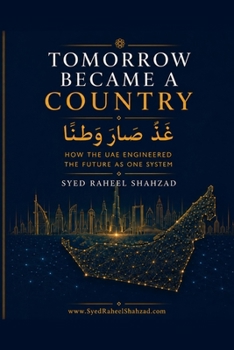
Tomorrow Became a Country: How the UAE Engineered the Future as One System

Tomorrow Became a Country is a systems-level study of how the United Arab Emirates transformed national ambition into a working model of governance, development, openness, and global influence.
The book does not treat the UAE's rise as a collection of separate achievements. It examines the deeper architecture beneath the visible outcome: how vision becomes law, how law becomes execution, how execution creates trust, how openness attracts people and capital, and how sustained institutional design turns a young federation into one of the world's most future-oriented countries.
Following the sequence Vision → Law → Execution → Openness → Growth → Global Influence, Syed Raheel Shahzad reads the UAE as a connected national system rather than as a skyline, a tourism story, or an oil economy. The result is a detailed inquiry into state capacity, economic diversification, infrastructure, safety, administration, human capital, global positioning, and the discipline required to make development measurable.
This is not a book of simple praise. Its governing principle is: proof is more truthful than praise. The book separates evidence from admiration, achievement from ambition, and measurable progress from unsupported claim. It also asks what cannot be copied, and why the UAE model depends on specific conditions of geography, capital, leadership, timing, population, openness, and institutional coherence.
Written by a long-term UAE resident, entrepreneur, and systems thinker who has lived and built inside the country since 2010, Tomorrow Became a Country offers a resident-builder's view of the UAE's transformation: close enough to understand the machinery of daily life, yet independent enough to ask how the system actually works.
For readers of governance, public policy, Gulf studies, economic development, leadership, institutional design, and nation-building, this book asks one central question: not how tall a country grew, but how it was built.
Customer Reviews
ThriftBooks ® and the ThriftBooks ® logo are registered trademarks of Thrift Books Global, LLC
