


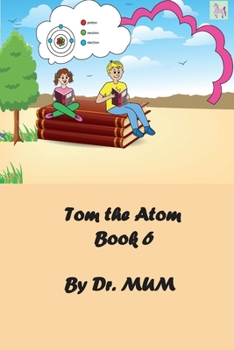
Tom the Atom, Book 6: Lithium, highly reactive and flammable, do not eat it; it may make you distractible!
No Customer Reviews

Tom the Atom, Book 6: Lithium, highly reactive and flammable, do not eat it; it may make you distractible Tom-the-Atom introduces you, Mary, and Henry, to her cousin Lithium the Li atom. Lithium belongs to the family of the Alkali Metals. Column 1, Group 1A, Lithium has two shells: a full, inner K shell with two electrons and an outer, L-shell, with only one valence electron (practically empty; L is complete with eight electrons). Column 1 of the Periodic Table Alkali Metals family is called Group 1A. All atoms in Column 1A has one outermost electron. But Hydrogen has only one shell and does not belong to the Alkali Metals family and is identified separately. All the others in Group 1A prefer to lose their outermost shell's electron than share the missing "empty sleeves" That is why Alkali Metals are very reactive By losing her solely outermost electron, which has a negative charge, the atom becomes positively charged (now has one more positive proton in her belly than electrons in her shells), and an atom that loses (or gains) a charge is called an ION.In the Periodic Table, a measure of how easy an atom gets his/her electron stolen or how easy it is for an atom grabs an electron is called Electro-negativity. Atoms with large electro-negativity are real thieves, while those with low electro-negativity are eager to lose their electrons to the thieves When that happens, the first atom becomes a negatively-charged ion while the second becomes a positively-charged ion. It happens that Positive Ions (has lost an electron) and Negative Ions (has stolen an electron) attract each other if they come close near. They form an IONIC Bond: The atom that had its electron taken and the thief that has gained electrons become friends Note that opposites charges ("+" and "-"charges) attract, but like charges ("+" and "+" or "-"and "-"charges) repel.
Format:Paperback
Language:English
ISBN:1712981420
ISBN13:9781712981429
Release Date:November 2019
Publisher:Independently Published
Length:30 Pages
Weight:0.15 lbs.
Dimensions:0.1" x 6.0" x 9.0"
Customer Reviews
0 rating
Copyright © 2026 Thriftbooks.com Terms of Use
| Privacy Policy | Do Not
Sell/Share My Personal Information | Cookie Policy | Cookie Preferences | Accessibility Statement
ThriftBooks® and the ThriftBooks® logo are registered trademarks of Thrift Books Global, LLC
ThriftBooks® and the ThriftBooks® logo are registered trademarks of Thrift Books Global, LLC
