


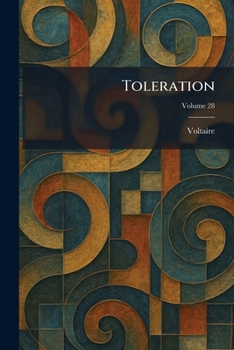
Toleration

"Toleration" is a seminal work of Enlightenment philosophy by Voltaire, one of the most influential thinkers of the eighteenth century. At its core, this treatise is a passionate and reasoned plea for religious freedom and the end of sectarian violence. Spurred by the pursuit of justice and the rejection of fanaticism, Voltaire uses his sharp wit and formidable intellect to dismantle the arguments for intolerance. He argues that mutual respect and freedom of conscience are not only moral imperatives but essential foundations for a peaceful and civilized society.
The work explores the historical and philosophical roots of persecution, contrasting the dogmatism of his era with the principles of reason and human compassion. By examining various cultures and historical periods, Voltaire demonstrates that diversity of belief is a natural state of humanity and that enforced conformity only leads to suffering and civil unrest. "Toleration" remains a cornerstone of modern secular thought, offering a timeless defense of the right to individual belief and a scathing critique of extremism. This powerful text continues to resonate today as an enduring testament to the necessity of pluralism and the pursuit of a more just and rational world.
This work has been selected by scholars as being culturally important, and is part of the knowledge base of civilization as we know it. This work was reproduced from the original artifact, and remains as true to the original work as possible. Therefore, you may see the original copyright references, library stamps (as most of these works have been housed in our most important libraries around the world), and other notations in the work.
This work is in the public domain in the United States of America, and possibly other nations. Within the United States, you may freely copy and distribute this work, as no entity (individual or corporate) has a copyright on the body of the work.
As a reproduction of a historical artifact, this work may contain missing or blurred pages, poor pictures, errant marks, etc. Scholars believe, and we concur, that this work is important enough to be preserved, reproduced, and made generally available to the public. We appreciate your support of the preservation process, and thank you for being an important part of keeping this knowledge alive and relevant.
Customer Reviews
ThriftBooks ® and the ThriftBooks ® logo are registered trademarks of Thrift Books Global, LLC
