


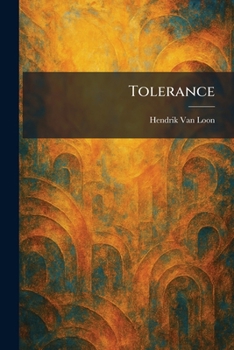
Tolerance

Select Format
Select Condition 
Book Overview
"Tolerance" is a profound and engaging exploration of the history of human struggle against prejudice, bigotry, and intellectual oppression. Written by the renowned historian Hendrik Van Loon, this work traces the evolution of human thought from the ancient world through the Middle Ages and the Reformation to the modern era. Van Loon examines the persistent conflict between authority and individual conscience, highlighting the figures and movements that have fought for the right to think and speak freely.
Through his signature narrative style, the author illustrates how various societies have treated dissent and diversity of thought. From the inquisitions of the past to the social pressures of the twentieth century, "Tolerance" serves as both a historical record and a passionate plea for open-mindedness and mutual respect. The book delves into the lives of great thinkers who challenged the status quo, often at great personal risk, to advance the cause of reason and intellectual liberty.
Rich in insight and timeless in its message, "Tolerance" remains an essential study of the fragile nature of freedom and the enduring importance of independence in a complex world. It is a landmark work in the field of popular history that continues to resonate with anyone interested in the social and moral development of humanity.
This work has been selected by scholars as being culturally important, and is part of the knowledge base of civilization as we know it. This work was reproduced from the original artifact, and remains as true to the original work as possible. Therefore, you may see the original copyright references, library stamps (as most of these works have been housed in our most important libraries around the world), and other notations in the work.
This work is in the public domain in the United States of America, and possibly other nations. Within the United States, you may freely copy and distribute this work, as no entity (individual or corporate) has a copyright on the body of the work.
As a reproduction of a historical artifact, this work may contain missing or blurred pages, poor pictures, errant marks, etc. Scholars believe, and we concur, that this work is important enough to be preserved, reproduced, and made generally available to the public. We appreciate your support of the preservation process, and thank you for being an important part of keeping this knowledge alive and relevant.
Customer Reviews
ThriftBooks® and the ThriftBooks® logo are registered trademarks of Thrift Books Global, LLC
