


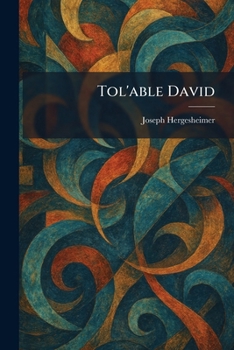
Tol'able David

"Tol' Able David" is a powerful tale of resilience and moral fortitude set in the rugged landscape of the Virginia mountains. Written by Joseph Hergesheimer, this classic of American regionalism tells the story of David Kinemon, a young man who finds himself the sole protector of his family after a series of brutal tragedies. When the lawless and violent Ison family arrives in the community, David is forced to transition abruptly from adolescence into adulthood to defend his home and uphold his family's honor.
The narrative is a masterful exploration of the David and Goliath archetype, set against the backdrop of rural Appalachia. Hergesheimer captures the atmospheric beauty and the harsh realities of mountain life with lyrical prose and psychological depth. The work is celebrated for its vivid characterizations and its exploration of duty, courage, and the transition of youth into manhood. A significant contribution to the early 20th-century American literary canon, "Tol' Able David" remains a poignant study of individual strength and the weight of legacy in the face of overwhelming adversity.
This work has been selected by scholars as being culturally important, and is part of the knowledge base of civilization as we know it. This work was reproduced from the original artifact, and remains as true to the original work as possible. Therefore, you may see the original copyright references, library stamps (as most of these works have been housed in our most important libraries around the world), and other notations in the work.
This work is in the public domain in the United States of America, and possibly other nations. Within the United States, you may freely copy and distribute this work, as no entity (individual or corporate) has a copyright on the body of the work.
As a reproduction of a historical artifact, this work may contain missing or blurred pages, poor pictures, errant marks, etc. Scholars believe, and we concur, that this work is important enough to be preserved, reproduced, and made generally available to the public. We appreciate your support of the preservation process, and thank you for being an important part of keeping this knowledge alive and relevant.
Customer Reviews
ThriftBooks ® and the ThriftBooks ® logo are registered trademarks of Thrift Books Global, LLC
