


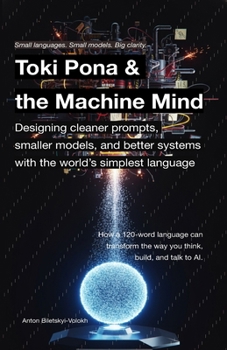
Toki Pona and the Machine Mind: Designing cleaner prompts, smaller models, and better systems with the world's simplest language
No Customer Reviews

What if the best way to design better AI systems isn't more scale or more data-but fewer words?
This book starts with a simple, radical premise: the world's simplest language, Toki Pona, may be one of the best tools we have for thinking clearly about large language models, prompt engineering, and small, efficient AI systems.
Toki Pona was created in 2001 by translator Sonja Lang as a language of extreme minimalism: roughly 120-140 root words, simple syntax, and a philosophy of clarity and calm. Two decades later, it has quietly become a perfect laboratory for the age of AI-where verbosity is expensive, ambiguity is dangerous, and every token has a cost. Toki Pona and the Machine Mind shows how this "toy language" becomes a serious engineering tool. It connects a tiny human-made language with the very large models that now mediate our work, communication, and decisions.
- Toki Pona as an engineered protocol - how a tiny lexicon, strict particles, and simple word order create "semantic pressure" that forces clarity.
- Sitelen Pona - the pictographic script of Toki Pona, where syntax becomes geometry and scope is encoded visually rather than statistically.
- Sitelen Emoji - a community-driven emoji script for Toki Pona, and what happens when you use emoji as a global icon layer for humans and models. Inside, you'll learn how to: Use Toki Pona as a prompt compression layer - reducing high-entropy natural language into stable, low-variance commands that models can interpret more reliably.Design your own constrained prompt DSLs inspired by Toki Pona: small vocabularies, strict syntax, and predictable outputs for both teams and agents.Think about small language models the right way: why small languages are not just compatible with SLMs, but often optimal.Throughout the book, you'll see "before / after" examples where dense, emotional or bureaucratic language is rewritten into compact Toki Pona-inspired protocols. The goal is not to be cute. The goal is to build deterministic, inspectable, and teachable interfaces between humans and AI. Who this book is forAI engineers and ML practitioners who are tired of prompt chaos and want more predictable systems.Product builders and founders designing AI-powered features, agents, or tools.Researchers and tinkerers interested in small models, constrained languages, and low-resource experiments.Members of the Toki Pona community who want to see their language used as a serious design and thinking tool.Educators, coaches, and leaders who need a clearer way to explain complex systems and help people think more cleanly in the AI era.You don't need to know Toki Pona before you start. The book contains a mini grammar, a dictionary, a technical vocabulary appendix, and plenty of worked examples. You can learn the language as you go.
If you suspect that "more" is no longer helping, and that the real advantage lies in less, done precisely, this book is for you.
This book starts with a simple, radical premise: the world's simplest language, Toki Pona, may be one of the best tools we have for thinking clearly about large language models, prompt engineering, and small, efficient AI systems.
Toki Pona was created in 2001 by translator Sonja Lang as a language of extreme minimalism: roughly 120-140 root words, simple syntax, and a philosophy of clarity and calm. Two decades later, it has quietly become a perfect laboratory for the age of AI-where verbosity is expensive, ambiguity is dangerous, and every token has a cost. Toki Pona and the Machine Mind shows how this "toy language" becomes a serious engineering tool. It connects a tiny human-made language with the very large models that now mediate our work, communication, and decisions.
What this book is about
This is not a textbook on linguistics and not just another AI hype book. It is a practical field guide for:
- Toki Pona as an engineered protocol - how a tiny lexicon, strict particles, and simple word order create "semantic pressure" that forces clarity.
- Sitelen Pona - the pictographic script of Toki Pona, where syntax becomes geometry and scope is encoded visually rather than statistically.
- Sitelen Emoji - a community-driven emoji script for Toki Pona, and what happens when you use emoji as a global icon layer for humans and models. Inside, you'll learn how to: Use Toki Pona as a prompt compression layer - reducing high-entropy natural language into stable, low-variance commands that models can interpret more reliably.Design your own constrained prompt DSLs inspired by Toki Pona: small vocabularies, strict syntax, and predictable outputs for both teams and agents.Think about small language models the right way: why small languages are not just compatible with SLMs, but often optimal.Throughout the book, you'll see "before / after" examples where dense, emotional or bureaucratic language is rewritten into compact Toki Pona-inspired protocols. The goal is not to be cute. The goal is to build deterministic, inspectable, and teachable interfaces between humans and AI. Who this book is forAI engineers and ML practitioners who are tired of prompt chaos and want more predictable systems.Product builders and founders designing AI-powered features, agents, or tools.Researchers and tinkerers interested in small models, constrained languages, and low-resource experiments.Members of the Toki Pona community who want to see their language used as a serious design and thinking tool.Educators, coaches, and leaders who need a clearer way to explain complex systems and help people think more cleanly in the AI era.You don't need to know Toki Pona before you start. The book contains a mini grammar, a dictionary, a technical vocabulary appendix, and plenty of worked examples. You can learn the language as you go.
If you suspect that "more" is no longer helping, and that the real advantage lies in less, done precisely, this book is for you.
Format:Paperback
Language:English
ISBN:B0G5MQKZTX
ISBN13:9798277857434
Release Date:December 2025
Publisher:Independently Published
Length:290 Pages
Weight:0.74 lbs.
Dimensions:0.6" x 5.5" x 8.5"
Customer Reviews
0 rating
Copyright © 2026 Thriftbooks.com Terms of Use
| Privacy Policy | Do Not
Sell/Share My Personal Information | Cookie Policy | Cookie Preferences | Accessibility Statement
ThriftBooks® and the ThriftBooks® logo are registered trademarks of Thrift Books Global, LLC
ThriftBooks® and the ThriftBooks® logo are registered trademarks of Thrift Books Global, LLC
