


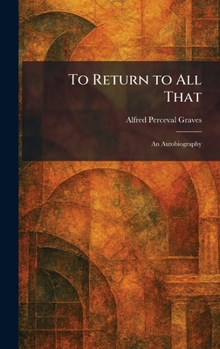
To Return to All That: An Autobiography

Select Format
Select Condition 
Book Overview
"To Return to All That: An Autobiography" provides an insightful and spirited account of the life of Alfred Perceval Graves, a leading figure in the Irish literary revival and a celebrated poet and songwriter. Written as a measured response to his son Robert Graves' famous memoir, "Goodbye to All That", this work offers a different vantage point on the family's history, the values of the Victorian and Edwardian eras, and the cultural shifts of the early 20th century.
The narrative explores Graves' multifaceted career as a school inspector, his deep involvement in the preservation of Irish folk songs, and his interactions with the prominent intellectual and literary circles of his day. Through his recollections, Graves paints a vivid picture of the Anglo-Irish experience, balancing personal anecdotes with broader cultural reflections. The work serves as a valuable historical document, capturing the professional and private life of a man dedicated to education and the arts. "To Return to All That: An Autobiography" is essential reading for those interested in Irish history, literary biography, and the complex generational dialogues that shaped modern literature.
This work has been selected by scholars as being culturally important, and is part of the knowledge base of civilization as we know it. This work was reproduced from the original artifact, and remains as true to the original work as possible. Therefore, you may see the original copyright references, library stamps (as most of these works have been housed in our most important libraries around the world), and other notations in the work.
This work is in the public domain in the United States of America, and possibly other nations. Within the United States, you may freely copy and distribute this work, as no entity (individual or corporate) has a copyright on the body of the work.
As a reproduction of a historical artifact, this work may contain missing or blurred pages, poor pictures, errant marks, etc. Scholars believe, and we concur, that this work is important enough to be preserved, reproduced, and made generally available to the public. We appreciate your support of the preservation process, and thank you for being an important part of keeping this knowledge alive and relevant.
Customer Reviews
ThriftBooks ® and the ThriftBooks ® logo are registered trademarks of Thrift Books Global, LLC
