


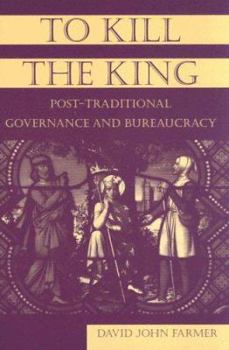
To Kill the King: Post-Traditional Governance and Bureaucracy


Select Format
Select Condition 
Book Overview
"To Kill the King" sketches post-traditional consciousness in terms of three concepts - thinking as play, justice as seeking, and practice as art. In a series of critical essays on each of these concepts, the book describes a post-traditional consciousness of governance that can yield improvement in the quality of life for each individual.
Format:Paperback
Language:English
ISBN:0765614812
ISBN13:9780765614810
Release Date:January 2005
Publisher:Routledge
Length:240 Pages
Weight:0.75 lbs.
Dimensions:0.6" x 6.3" x 8.9"
Customer Reviews
1 rating
Thought provoking
Published by Thriftbooks.com User , 18 years ago
To Kill The King by Dr. David John Farmer was written to create a post-traditional consciousness that asks the reader to think about a future state of governance and bureaucracy unlike that which exists today. Do we have the ultimate democracy today or is there another plateau that we have not yet reached? Farmer's work is divided into three sections that challenge the reader on questions and issues in post-traditional thinking, post-traditional justice, and post-traditional practice. The author makes a number of thought-provoking and controversial assertions throughout his book These assertions being: 1.) post-traditional thinking is using your imagination, 2.) post-traditional justice represents a shift from hierarchical to horizontal governance models, and 3.) post-traditional practice is more art than science. Controversy, however, might be exactly what Farmer intended in order to force dialogue on the issues. The author encourages an integrated view of politics, philosophy and economics as the focal point for future thinking and governance frameworks. He encourages dialogue because change does not occur in a good way for society without it. Farmer claims that post-traditional thinking requires new symbols. Today's symbols represent powerful paradigms that must be broken to move society to a new state of consciousness. Those symbols take forms like large government buildings in a bureaucracy and corporate executives sitting in their mahogany paneled offices on the top floor of their steel empires. It is not clear what forms and shapes new symbols should take and how the old symbols can be smashed and changed without some violent societal upheaval. Post-traditional justice is a subject that requires dialogue because it must be socially constructed. Justice is in the eye of the one seeking justice, which must be explored and debated in the context of the situation. Views on what represents justice diverge whether they are philosophical, political or religious. Does the death penalty represent final justice for the murderer or does rehabilitating the murderer provide final justice for society? This concept of justice as seeking is one of the more thought-provoking discussions in Farmer's work. The third section of Farmer's work challenges current paradigms associated with bureaucracy and public administration. Farmer claims that we must abandon the idea of leaders as heroic, the concept of society as hierarchical, the bifurcation of society into economic and non-economic parts, and the labeling of public administration as a science. Post-traditional practice of public administration cannot occur without resymbolization. It also cannot occur by justifying the current state as good. Farmer's work is relevant because as a society we seem to be searching for new models of governance and democracy. We often hear the cry to reinvent government but we cannot envision what that reinvention looks like. We do not like the capital
Copyright © 2026 Thriftbooks.com Terms of Use
| Privacy Policy | Do Not
Sell/Share My Personal Information | Cookie Policy | Cookie Preferences | Accessibility Statement
ThriftBooks® and the ThriftBooks® logo are registered trademarks of Thrift Books Global, LLC
ThriftBooks® and the ThriftBooks® logo are registered trademarks of Thrift Books Global, LLC
