


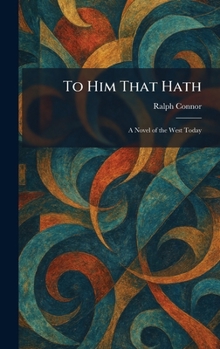
To Him That Hath: A Novel of the West Today

"To Him That Hath: A Novel of the West Today" focuses on the social and economic tensions that defined the post-World War I era in the Canadian West. The narrative unfolds in a community strained by industrial conflict, where the divide between labor and management threatens the social fabric. At the heart of the story are characters striving for justice and reconciliation amidst the chaos of strikes and class warfare, reflecting the broader societal search for stability and purpose in the aftermath of a global conflict.
Ralph Connor utilizes this setting to examine the ethical dilemmas faced by those in positions of power and those seeking a voice in the new world order. The work is deeply rooted in the social gospel movement, emphasizing the intersection of religious conviction and social activism. Through its dramatic portrayal of personal transformation and civic duty, the novel provides a window into the cultural and political climate of the 1920s. "To Him That Hath" remains a significant work of Canadian fiction, capturing the idealistic yet fraught spirit of an age trying to reconstruct its values and institutions for a better future.
This work has been selected by scholars as being culturally important, and is part of the knowledge base of civilization as we know it. This work was reproduced from the original artifact, and remains as true to the original work as possible. Therefore, you may see the original copyright references, library stamps (as most of these works have been housed in our most important libraries around the world), and other notations in the work.
This work is in the public domain in the United States of America, and possibly other nations. Within the United States, you may freely copy and distribute this work, as no entity (individual or corporate) has a copyright on the body of the work.
As a reproduction of a historical artifact, this work may contain missing or blurred pages, poor pictures, errant marks, etc. Scholars believe, and we concur, that this work is important enough to be preserved, reproduced, and made generally available to the public. We appreciate your support of the preservation process, and thank you for being an important part of keeping this knowledge alive and relevant.
Customer Reviews
ThriftBooks ® and the ThriftBooks ® logo are registered trademarks of Thrift Books Global, LLC
