


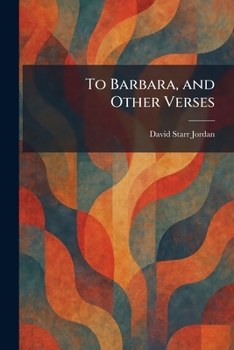
To Barbara, and Other Verses

"To Barbara, and Other Verses" is a poignant collection of poetry by David Starr Jordan, the distinguished scientist and founding president of Stanford University. This volume gathers a selection of heartfelt verses that showcase a more intimate and contemplative side of Jordan's intellectual life. The centerpiece of the collection is the titular poem dedicated to his daughter, Barbara, reflecting on themes of loss, memory, and parental love.
Beyond these personal elegies, the book includes various other verses that touch upon nature, philosophy, and the human experience. Jordan's writing is characterized by its clarity and emotional resonance, offering readers a glimpse into the private thoughts of a man otherwise known for his major contributions to ichthyology and academia. These poems serve as a testament to the power of verse to capture the complexities of grief and the quiet beauty of the natural world. This collection remains a significant work for those interested in the literary output of prominent American figures of the early 20th century and for readers of classic American poetry.
This work has been selected by scholars as being culturally important, and is part of the knowledge base of civilization as we know it. This work was reproduced from the original artifact, and remains as true to the original work as possible. Therefore, you may see the original copyright references, library stamps (as most of these works have been housed in our most important libraries around the world), and other notations in the work.
This work is in the public domain in the United States of America, and possibly other nations. Within the United States, you may freely copy and distribute this work, as no entity (individual or corporate) has a copyright on the body of the work.
As a reproduction of a historical artifact, this work may contain missing or blurred pages, poor pictures, errant marks, etc. Scholars believe, and we concur, that this work is important enough to be preserved, reproduced, and made generally available to the public. We appreciate your support of the preservation process, and thank you for being an important part of keeping this knowledge alive and relevant.
Customer Reviews
ThriftBooks ® and the ThriftBooks ® logo are registered trademarks of Thrift Books Global, LLC
