


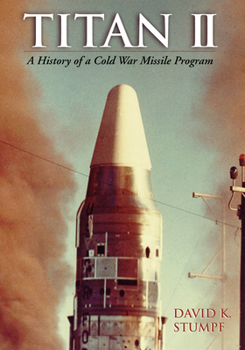
Titan II: A History of a Cold War Missile Program

Select Format
Select Condition 
Book Overview
The missiles carried the largest nuclear warhead in the US arsenal; used liquid fuel propellant; and were launched from hardened underground silos in Arkansas, Arizona, and Kansas. They were deployed... This description may be from another edition of this product.
Format:Hardcover
Language:English
ISBN:1557286019
ISBN13:9781557286017
Release Date:July 2002
Publisher:University of Arkansas Press
Length:352 Pages
Weight:2.00 lbs.
Dimensions:1.3" x 7.4" x 10.4"
Customer Reviews
5 ratings
The Backbone of U.S. Strategic Forces
Published by Thriftbooks.com User , 17 years ago
I loved this book through and through. The coverage of doctrine, policy from the U.S. leadership to the "in the trenches" view from the wing/squadron/flight level was amazing. The Titan family has been a stalwart throughout the Cold War - as ICBMs, Space Launch Vehicles, boosting Gemini capsules into orbit... and its cousins boosting national reconnaissance satellites in later decades. I liked the fact that it was written as a historical study from a non-military source. If there is bias in the book it is from the historian perspective and not the party-line offered by the U.S. military. With today's Air Force missileers screwing up left and right, its nice to read a history of their figurative grandfathers and fathers doing the job correctly to keep the Russian Bear at bay. Recommended: Disaster at Silo 7, Star Trek: First Contact (alternative uses for a Titan II???), The Day After (don't put a Titan II silo in your backyard...)
You need this book...
Published by Thriftbooks.com User , 19 years ago
Wow another wonderful cold war missile history book.This book is so imformative it get right down to the nuts and bolts that kept this mighty missile together.If you want to learn about what Titan was and what it did to protect us then get this book now trust me it's that good.
A definitive, strongly recommended, technological history
Published by Thriftbooks.com User , 23 years ago
Compiled and written by David K. Stumpf (Associate Research Scientist, University of Arizona), Titan II: A History of a Cold War Missile Program is the informed and informative story of the intercontinental ballistic missile program developed by the United States military in the 1950s and 1960s. Each missile was designed to carry a single nuclear warhead, used liquid fuel propellants, and was stored (and launched from) hardened underground silos. The missile sites were based in Arkansas, Arizona, and Kansas facilities, and then were finally deactivated in the early 1980s. Based on a wide range of sources including engineer and airmen interviews and memoirs, declassified government documents, and other public materials, and enhanced with more than 170 drawings and photographs (most of which have never been previously published), Titan II is a definitive, strongly recommended, technological history of a deterrent weapons system that for more than 20 years successfully defended America from nuclear attack.
Thorough and entertaining
Published by Thriftbooks.com User , 24 years ago
I was expecting the typical academic or historical reference that is chock full of info, but fairly dull to read. As the cliche goes, you can't judge a book by its cover. Mr. Stumpf has done a great job of writing also. He details the beginnings of the program, operational aspects and the fatal accidents which seem to have been forgotten over the years.He even details the program to turn the old warhorses into satellite launch vehicles and the remaining silo, now a musuem in Arizona.Like the previous reviewer, I would have liked to seen some info on the Titan II and the Gemini program.If you're a space or Cold War buff, read this book, then visit the silo/museum in Green Valley, Ariz.
A Great, Detailed History of A Missile Program
Published by Thriftbooks.com User , 25 years ago
There are a number of good books on the history of ballistic missiles. Edmund Beard, Richard Armacost and Harold Sapolski have all written classic books on the management of early ballistic missile programs. There are some more recent books that either re-cover this earlier ground or add to it. However, there are no real technical histories devoted to the development of any of the ballistic missiles the United States has built over the years. This book begins to fill that void.David Stumpf previously wrote a book on the Navy's Regulus cruise missile that is a pretty comprehensive history. He did a good job with that one. Now he has turned his attention to the Titan II and done another great job.Titan II is a detailed history of the development of the United States' second ICBM (technically, it could be considered the third, since it bears only limited resemblance to the Titan I that preceded it). This is a book focused on the technical development of the missile, the development and construction of its launch silos, its launch tests, its operational history, and its retirement from service in the 1980s. It is filled with illustrations, most of which have never been published before. And it is clear from his sources that he did not simply review previously published articles on the Titan II, but interviewed the people who worked on it and gathered information from private archives and previously classified materials.The book does not go into the development of the space launch version of the Titan. The history of the development of the Titan III and the Titan IV rockets still awaits writing. He does, however, include a chapter on the refurbishment of old Titan II ICBMs into launch vehicles during the 1980s. Stumpf includes an interesting discussion of the development of missile reentry vehicles. This is a subject that I personally believe could use a book in itself. I think it would be fascinating to trace the development of this technology.Stumpf also includes an extensive discussion of several accidents involving the Titan II. And he discusses how and why the missiles were ultimately removed from service.There are also useful appendices at the end of the book, listing the various flight tests (and their accuracy), the missiles produced, and other details.We can only hope that he turns his attention to other early Cold War missile programs. This is an impressive piece of work.
Copyright © 2026 Thriftbooks.com Terms of Use
| Privacy Policy | Do Not
Sell/Share My Personal Information | Cookie Policy | Cookie Preferences | Accessibility Statement
ThriftBooks® and the ThriftBooks® logo are registered trademarks of Thrift Books Global, LLC
ThriftBooks® and the ThriftBooks® logo are registered trademarks of Thrift Books Global, LLC
