


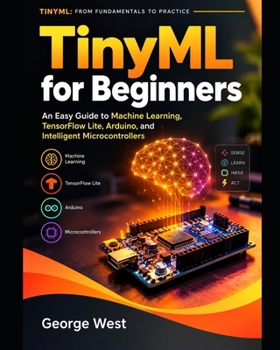
TinyML for Beginners: An Easy Guide to Machine Learning, TensorFlow Lite, Arduino, and Intelligent Microcontrollers (Series: TinyML: From Fundamentals to Practice)

What if machine learning could run directly on a tiny microcontroller instead of relying on a powerful computer or cloud server?
That is the idea behind TinyML-bringing machine learning and artificial intelligence to devices with extremely limited memory, processing power, storage, and energy. From intelligent sensors and wearables to voice interfaces, motion detection, and smart embedded devices, TinyML is making it possible to build AI-powered systems that operate directly at the edge.
TinyML for Beginners provides a practical introduction to this rapidly growing field and takes you step by step from machine-learning fundamentals to deploying models on resource-constrained hardware.
You'll learn how TinyML works, how machine-learning models are trained and prepared for embedded environments, and how tools such as TensorFlow Lite for Microcontrollers can transform trained models into applications capable of running on microcontrollers and Arduino-compatible hardware.
Rather than assuming extensive experience in machine learning or embedded development, this book gradually introduces the concepts, tools, workflows, and techniques needed to begin building intelligent devices.
Inside This Book, You'll Learn How To:Understand the fundamentals of machine learning and TinyML
Explore how AI can operate on resource-constrained microcontrollers
Understand the TinyML development workflow from data collection to deployment
Prepare and process datasets for embedded machine-learning applications
Train, evaluate, and improve machine-learning models
Convert models for deployment on small devices
Work with TensorFlow Lite for Microcontrollers
Develop TinyML applications with Arduino and microcontrollers
Use sensor and accelerometer data for machine learning
Build applications involving audio, motion, and other embedded inputs
Understand model quantization and other optimization techniques
Work within memory, storage, processing, and power limitations
Debug common problems in embedded machine-learning applications
Understand latency, energy consumption, and model-size trade-offs
Apply practical privacy and security considerations to edge AI
The book emphasizes understanding through implementation, helping you connect machine-learning concepts with the realities of embedded hardware.
Whether you're a developer exploring embedded AI, an electronics enthusiast interested in machine learning, an IoT developer, a student, or a machine-learning practitioner looking to move beyond cloud-based inference, this book gives you a structured starting point for entering the world of TinyML.
Start small. Think intelligently. Build AI-powered devices at the edge.
Customer Reviews
ThriftBooks ® and the ThriftBooks ® logo are registered trademarks of Thrift Books Global, LLC
