


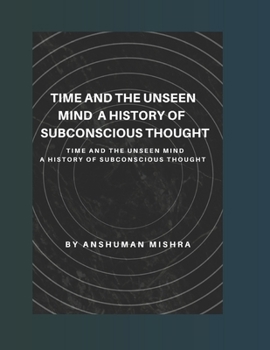
Time and the Unseen Mind A History of Subconscious Thought
No Customer Reviews

Introduction: The Hidden History Beneath Human History
Every civilization is built not merely upon stones, laws, or technologies, but upon dreams - the invisible architectures of thought that shape how people see themselves and the world. Beneath the familiar narrative of kings, wars, and inventions, there flows a deeper and subtler current: the history of the human subconscious.
It is an unrecorded history, written not in ink but in myth, ritual, art, and intuition. This book, Time and the Unseen Mind, seeks to trace that hidden current - the evolving idea of the subconscious - from ancient mystical traditions to modern artificial intelligence.
In doing so, it asks a profound question: how has humanity's understanding of its own mind changed across time? And what does this evolution reveal about who we are - and what we may yet become?
The journey begins in the ancient world, where shamans, priests, and philosophers first glimpsed the inner life. It continues through the ages of faith and reason, through the Renaissance mirror of self-discovery, through the birth of psychology, and into the modern era where machines begin to simulate awareness.
At every stage, human beings have projected their own hidden depths outward - into gods, symbols, stories, and systems - creating civilizations that are themselves reflections of the collective unconscious.
This book is not only a historical survey but also a philosophical meditation on how civilizations dream - and how those dreams become the foundations of consciousness itself. Why This Book Matters: The Forgotten Story of the Subconscious
Modern science and technology have advanced astonishingly, yet in the midst of this progress, humanity remains haunted by the oldest of mysteries: What is the mind?
We can measure brain waves, analyze dreams, and simulate cognition in code, but we still do not fully understand the hidden layers of thought that shape emotion, memory, and imagination.
While psychology has explored the subconscious for little more than a century, the intuition of an unseen mental world is as old as humanity itself. Ancient shamans entered trance to commune with unseen forces. Philosophers from India, Greece, and China pondered the layers of being. Mystics spoke of divine union and the darkness of the soul. Every era, in its own language, tried to articulate what modern thinkers now call the subconscious.
Yet few histories of the mind take this long, cross-cultural view. Most begin with Freud and end with neuroscience. Time and the Unseen Mind breaks that boundary. It restores the deep continuity between myth and psychology, ritual and cognition, symbol and algorithm.
This is important because understanding the subconscious is not only a matter of science - it is a matter of identity.
To know how the hidden mind has been imagined, feared, and revered through time is to understand how humanity has seen itself in every age.
Just as archaeology uncovers buried cities, this book excavates the buried thoughts beneath civilization - the forgotten metaphors, archetypes, and symbols that continue to shape our behavior, art, and technology today. The Central Thesis: Civilization as a Dream of the Collective Mind
Time and the Unseen Mind proposes that civilization itself is a psychological phenomenon - a kind of collective dream.
Each culture, through its myths, architecture, language, and technology, expresses what it unconsciously believes about the nature of reality and the self.
The ziggurats of Mesopotamia, the temples of India, the cathedrals of Europe, and the data centers of the digital age are not only structures - they are material projections of inner states.
When we build cities,
Every civilization is built not merely upon stones, laws, or technologies, but upon dreams - the invisible architectures of thought that shape how people see themselves and the world. Beneath the familiar narrative of kings, wars, and inventions, there flows a deeper and subtler current: the history of the human subconscious.
It is an unrecorded history, written not in ink but in myth, ritual, art, and intuition. This book, Time and the Unseen Mind, seeks to trace that hidden current - the evolving idea of the subconscious - from ancient mystical traditions to modern artificial intelligence.
In doing so, it asks a profound question: how has humanity's understanding of its own mind changed across time? And what does this evolution reveal about who we are - and what we may yet become?
The journey begins in the ancient world, where shamans, priests, and philosophers first glimpsed the inner life. It continues through the ages of faith and reason, through the Renaissance mirror of self-discovery, through the birth of psychology, and into the modern era where machines begin to simulate awareness.
At every stage, human beings have projected their own hidden depths outward - into gods, symbols, stories, and systems - creating civilizations that are themselves reflections of the collective unconscious.
This book is not only a historical survey but also a philosophical meditation on how civilizations dream - and how those dreams become the foundations of consciousness itself. Why This Book Matters: The Forgotten Story of the Subconscious
Modern science and technology have advanced astonishingly, yet in the midst of this progress, humanity remains haunted by the oldest of mysteries: What is the mind?
We can measure brain waves, analyze dreams, and simulate cognition in code, but we still do not fully understand the hidden layers of thought that shape emotion, memory, and imagination.
While psychology has explored the subconscious for little more than a century, the intuition of an unseen mental world is as old as humanity itself. Ancient shamans entered trance to commune with unseen forces. Philosophers from India, Greece, and China pondered the layers of being. Mystics spoke of divine union and the darkness of the soul. Every era, in its own language, tried to articulate what modern thinkers now call the subconscious.
Yet few histories of the mind take this long, cross-cultural view. Most begin with Freud and end with neuroscience. Time and the Unseen Mind breaks that boundary. It restores the deep continuity between myth and psychology, ritual and cognition, symbol and algorithm.
This is important because understanding the subconscious is not only a matter of science - it is a matter of identity.
To know how the hidden mind has been imagined, feared, and revered through time is to understand how humanity has seen itself in every age.
Just as archaeology uncovers buried cities, this book excavates the buried thoughts beneath civilization - the forgotten metaphors, archetypes, and symbols that continue to shape our behavior, art, and technology today. The Central Thesis: Civilization as a Dream of the Collective Mind
Time and the Unseen Mind proposes that civilization itself is a psychological phenomenon - a kind of collective dream.
Each culture, through its myths, architecture, language, and technology, expresses what it unconsciously believes about the nature of reality and the self.
The ziggurats of Mesopotamia, the temples of India, the cathedrals of Europe, and the data centers of the digital age are not only structures - they are material projections of inner states.
When we build cities,
Format:Paperback
Language:English
ISBN:B0FXFLWNKD
ISBN13:9798271095610
Release Date:October 2025
Publisher:Independently Published
Length:126 Pages
Weight:0.68 lbs.
Dimensions:0.3" x 8.5" x 11.0"
Related Subjects
HistoryCustomer Reviews
0 rating
Copyright © 2026 Thriftbooks.com Terms of Use
| Privacy Policy | Do Not
Sell/Share My Personal Information | Cookie Policy | Cookie Preferences | Accessibility Statement
ThriftBooks® and the ThriftBooks® logo are registered trademarks of Thrift Books Global, LLC
ThriftBooks® and the ThriftBooks® logo are registered trademarks of Thrift Books Global, LLC
