


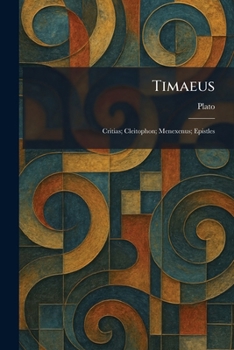
Timaeus: Critias; Cleitophon; Menexenus; Epistles

"Timaeus; Critias; Cleitophon; Menexenus; Epistles" is a significant collection of works by Plato that explores the boundaries of cosmology, political history, and personal philosophy. In "Timaeus", Plato presents a profound account of the formation of the universe, introducing the concept of a divine craftsman and the mathematical principles that govern the physical world. This is followed by the "Critias", which provides the earliest detailed narrative of the legendary island of Atlantis and its conflict with ancient Athens.
The volume also includes the "Cleitophon", a short but provocative dialogue questioning the practical application of Socratic ethics, and the "Menexenus", a funeral oration that serves as both a patriotic tribute and a subtle critique of Athenian rhetoric. Finally, the "Epistles" offer a rare glimpse into the philosopher's personal life and political engagements, most notably the Seventh Letter, which details his attempts to influence the government of Syracuse. Together, these writings offer a comprehensive look at the breadth of Plato's thought, from the origins of the cosmos to the complexities of human governance and autobiography.
This work has been selected by scholars as being culturally important, and is part of the knowledge base of civilization as we know it. This work was reproduced from the original artifact, and remains as true to the original work as possible. Therefore, you may see the original copyright references, library stamps (as most of these works have been housed in our most important libraries around the world), and other notations in the work.
This work is in the public domain in the United States of America, and possibly other nations. Within the United States, you may freely copy and distribute this work, as no entity (individual or corporate) has a copyright on the body of the work.
As a reproduction of a historical artifact, this work may contain missing or blurred pages, poor pictures, errant marks, etc. Scholars believe, and we concur, that this work is important enough to be preserved, reproduced, and made generally available to the public. We appreciate your support of the preservation process, and thank you for being an important part of keeping this knowledge alive and relevant.
Customer Reviews
ThriftBooks ® and the ThriftBooks ® logo are registered trademarks of Thrift Books Global, LLC
