


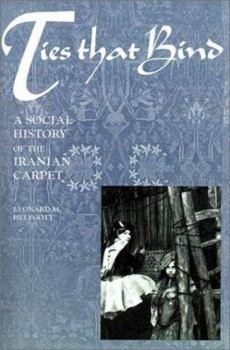
Ties that Bind


This social history of Iranian carpets traces their production, use, and exchange from the fifteenth century until World War II, highlighting in particular the carpet boom from 1873 to 1914. Over... This description may be from another edition of this product.
Format:Paperback
Language:English
ISBN:156098726X
ISBN13:9781560987260
Release Date:September 1996
Publisher:Smithsonian
Length:358 Pages
Weight:1.25 lbs.
Dimensions:8.8" x 1.0" x 5.8"
Customer Reviews
2 ratings
The Ties That Bind
Published by Thriftbooks.com User , 18 years ago
I just finished "The Ties That Bind", by Helfgott Leonard. I have to say that I was surprised on how much I ended up liking it and got out of it. I had a slightly hard time in the beginning with it. As I found the writing on the dry side. Though as the book progressed it seemed to get better. Whether it was the author loosening up or myself just getting used to the style, I am not sure. Though style aside, I found the book to be a marvel at filling all of the blanks that oriental rug books leave you with. Most books dealing with oriental rugs talk about where a village that could have made a particular rug is or which way the wool is twisted or the number of knots per square inch for a particular type of carpet. Though few ever really talk about the people behind the looms. Whether it is a weaver or producer. The book also takes the Iranian oriental rug industry out of the vacuum that it seems to fall into in most books and puts it into context with the rest of the world at different times up to the 1940's. This reason alone makes the book worth buying. As you see the outside influences that really caused such massive change in Iran. This is true not only in the business world but also culturally for them as well. I don't think this book is for everyone. It is not a light reading book, but a scholarly book for the person interested in the oriental rug business or in the history of Iran. For this person I would highly recommend it. Being in the oriental rug business for about twenty years. I found that it talked about a side of the business that rarely gets discussed. It was exciting too me in this way and I found that I learned a lot. Kudos to Mr. Helfgott
Worth Reading (with caveat)
Published by Thriftbooks.com User , 23 years ago
For those who are interested in the economics and sociology of the carpet industry in Iran, this is the book. Helfgott's book gives a good overview of the development of how the West has influenced both carpetmaking and technique, and also convincingly sets forth the case against both Western importers and those involved in industrial scale production for unfair labor practices persisting until today. The book is marred, however, by a somewhat academic writing style and and a haughty stance the author takes vis a vis Western carpet collectors (though I'll bet he owns some). Sometimes the reader gets the unpleasant impression that Helfgott is writing to impress other academics with his politically correct views and verbiage. He uses words which it seems he thinks are more exact, like "Temur Lenk" for example, instead of the generally used "Tamerlane" for example, despite the fact that "Temur Lenk" is merely the Arabic version of the Persian "Timur-i-lang" (Temur the Lame). Temur, of course, was neither Arab nor Persian, but Turkic from Central Asia, and was actually called "Amir Temur". On the whole, the book in general is worth reading for its information, so long as one is prepared to wade through some annoying bits of professorial snobbishness.
Copyright © 2026 Thriftbooks.com Terms of Use
| Privacy Policy | Do Not
Sell/Share My Personal Information | Cookie Policy | Cookie Preferences | Accessibility Statement
ThriftBooks® and the ThriftBooks® logo are registered trademarks of Thrift Books Global, LLC
ThriftBooks® and the ThriftBooks® logo are registered trademarks of Thrift Books Global, LLC
