


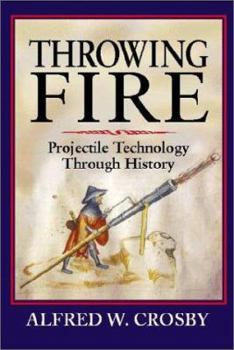
Throwing Fire: Projectile Technology Through History

Select Format
Select Condition 
Book Overview
In Throwing Fire, historian Alfred W. Crosby looks at hard, accurate throwing and the manipulation of fire as unique human capabilities. Humans began throwing rocks in prehistory and then progressed to javelins, atlatls, bows and arrows. We learned to make fire by friction and used it to cook, drive game, burn out rivals, and alter landscapes to our liking. Our exploitation of these two capabilities figured in the extinction of many species, and may have played a role in the demise of Neanderthals. In historic times we invented catapults, trebuchets, and such flammable liquids as Greek Fire, a napalm-like substance that stuck to whatever it hit and could not be extinguished with water. About 1,000 years ago we invented gunpowder, which led to guns and rockets, enabling us to literally throw fire. Gunpowder weaponry accelerated the rise of empires and the advance of European imperialism. In the 20th century, gunpowder weaponry enabled us to achieve unprecedented mayhem--the most destructive wars of all time. This trend peaked at the end of World War II with the V-2 and atomic bomb, at which point species suicide became possible. Faced with possible extinction should we experience World War III, we have turned our projectile talents to space travel which may make it possible for our species to migrate to other bodies of our solar system and even other star systems. Alfred W. Crosby is the author of the widely popular and ground-breaking books The Measure of Reality (Cambridge, 1996), America's Forgotten Pandemic (Cambridge, 1990) and Ecological Imperialism (Cambridge, 1986). He taught at the University of Texas, Austin for over 20 years. His books have received the Ralph Waldo Emerson Prize, the Medical Writers Association Prize and been named by the Los Angeles Times as among the best books of the year.
Format:Hardcover
Language:English
ISBN:0521791588
ISBN13:9780521791588
Release Date:April 2002
Publisher:Cambridge University Press
Length:218 Pages
Weight:1.00 lbs.
Dimensions:0.8" x 6.3" x 9.3"
Customer Reviews
1 rating
Interesting History and Commentary
Published by Thriftbooks.com User , 24 years ago
This book has some similiarities with Jared Diamond's wonderful "Gun's, Germs and Steel", but it is much more focused. Crosby discusses the historical use of projectile weapons by humans (and hominids), and how in a lot of ways, this helps to define humanity. No other animal has shown the ability to throw hard, far, and with accuracy, and this ability might have been crucial to the adoption of a terrestial lifestyle by our ancient ancestors. Throwing stones at predators might just have been key to allowing Australopithecenes to survive. The use of fire is also a key characteristic of humans, and with it humanity has helped shaped the environment to suit our purposes. Moving on from simple stones; through javelins; atlatls; slings; bows; siege engines; and, finally, chemically propelled projectiles (which mix fire and throwing), including satellites that have left our solar system, Crosby shows how developments in projectile technology have helped shaped history as we know it. This book is an interesting read, and is very well footnoted. Those interested in such areas as general anthropology, historical science and military science might also find book quite enjoyable.
Copyright © 2026 Thriftbooks.com
Terms of Use | Privacy Policy | Do Not Sell/Share My Personal Information | Cookie Notice | Cookie Preferences | Accessibility Statement
ThriftBooks ® and the ThriftBooks ® logo are registered trademarks of Thrift Books Global, LLC
ThriftBooks ® and the ThriftBooks ® logo are registered trademarks of Thrift Books Global, LLC
