


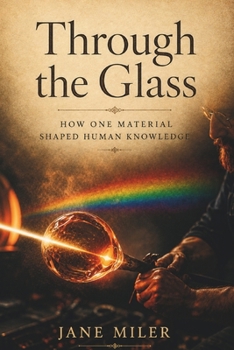
Through The Glass: How One Material Shaped Human Knowledge

In Cairo, Ibn al-Haytham established how light travels and how curved glass bends it. In Baghdad, a generation earlier, Ibn Sahl had already set down the law of refraction - six centuries before Snell derived it in Leiden. The mathematics existed. The manuscripts survived, were translated into Latin, and were printed and taught across Europe.
And nothing happened, until 1608, when a spectacle-maker in a small Dutch port put two lenses in a tube and could not have told you why it worked.
This book is an argument about that gap - and about a material almost nobody thinks of as an instrument.
Glass is the only substance available before the nineteenth century that is simultaneously transparent, chemically inert, sealable, heat-tolerant, and dimensionally stable. That combination is why the founding apparatus of quantitative science - the flask, the sealed tube, the barometer, the prism - is all made of the same thing.
Through the Glass follows it:
Why a Roman price-fixing edict listing glass by the pound matters more than the Portland VaseHow Venice built a two-century monopoly on knowledge that could not be written down, and why the monopoly that protected it also froze itWhy the spectacle trade - and therefore the telescope - was created by the printing pressHow a philosopher in 1835 chose the composition of the stars as his example of the permanently unknowable, and was refuted within a generation by a former glassmaker's apprenticeWhy glass is now being asked to hold nuclear waste for longer than writing has existedAnd then it argues against itself. The closing chapters state the case for the prosecution at full strength: that the whole enterprise is Eurocentric by construction, that its central counterfactual cannot be tested, that the great divergence happened far later and for entirely different reasons, and that printing and institutions may do most of the explanatory work. Two of those charges are conceded without an answer. One of them costs the book a claim it was fond of.
For readers of Stuff Matters, Salt, and The Great Divergence - and for anyone who has ever wondered how much of what we know was decided by what our ancestors happened to be able to make.
Related Subjects
Engineering Science Science & Math Science & Scientists Science & Technology TechnologyCustomer Reviews
ThriftBooks ® and the ThriftBooks ® logo are registered trademarks of Thrift Books Global, LLC
