


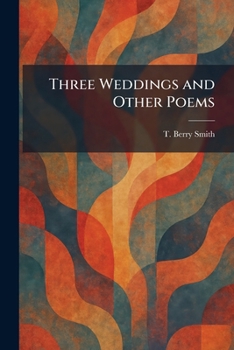
Three Weddings and Other Poems

Select Format
Select Condition 
Book Overview
"Three Wedings and Other Poems" is an evocative collection of verse by T. Berry Smith, showcasing the lyrical and sentimental style prevalent in early twentieth-century American literature. This volume brings together a series of poems that explore themes of love, devotion, and the rhythms of daily life, anchored by the central narrative of the titular wedding pieces.
Smith's poetry is noted for its accessible language and rhythmic structure, appealing to a wide audience with its focus on the beauty of human relationships and the natural world. The collection captures a sense of nostalgia and moral clarity, reflecting the author's background and the cultural atmosphere of 1920s America. From celebratory odes to quiet, reflective lyrics, the work demonstrates a mastery of traditional poetic forms and a deep appreciation for the shared experiences that bind communities together.
As a significant piece of regional literary history, "Three Wedings and Other Poems" offers readers a glimpse into the heart of American verse from a bygone era. It remains a poignant example of the power of poetry to document the milestones and emotions that define the human condition.
This work has been selected by scholars as being culturally important, and is part of the knowledge base of civilization as we know it. This work was reproduced from the original artifact, and remains as true to the original work as possible. Therefore, you may see the original copyright references, library stamps (as most of these works have been housed in our most important libraries around the world), and other notations in the work.
This work is in the public domain in the United States of America, and possibly other nations. Within the United States, you may freely copy and distribute this work, as no entity (individual or corporate) has a copyright on the body of the work.
As a reproduction of a historical artifact, this work may contain missing or blurred pages, poor pictures, errant marks, etc. Scholars believe, and we concur, that this work is important enough to be preserved, reproduced, and made generally available to the public. We appreciate your support of the preservation process, and thank you for being an important part of keeping this knowledge alive and relevant.
Customer Reviews
ThriftBooks ® and the ThriftBooks ® logo are registered trademarks of Thrift Books Global, LLC
