


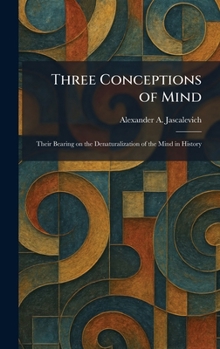
Three Conceptions of Mind: Their Bearing on the Denaturalization of the Mind in History

Through a rigorous analysis of historical thought, Alexander A. Jascalevich investigates how philosophical and psychological constructs have influenced the way humanity perceives its own mental processes. The book provides a critical bridge between early modern philosophy and the burgeoning psychological theories of the early twentieth century. It remains a significant contribution to the study of the history of ideas, offering insights into the metaphysical underpinnings of mental science.
Readers interested in the intersection of philosophy, history, and psychology will find this text a compelling examination of the intellectual shifts that defined the modern conception of the self. By evaluating the denaturalization process, the author challenges readers to consider the cultural and historical forces that dictate our understanding of what it means to possess a mind.
This work has been selected by scholars as being culturally important, and is part of the knowledge base of civilization as we know it. This work was reproduced from the original artifact, and remains as true to the original work as possible. Therefore, you may see the original copyright references, library stamps (as most of these works have been housed in our most important libraries around the world), and other notations in the work.
This work is in the public domain in the United States of America, and possibly other nations. Within the United States, you may freely copy and distribute this work, as no entity (individual or corporate) has a copyright on the body of the work.
As a reproduction of a historical artifact, this work may contain missing or blurred pages, poor pictures, errant marks, etc. Scholars believe, and we concur, that this work is important enough to be preserved, reproduced, and made generally available to the public. We appreciate your support of the preservation process, and thank you for being an important part of keeping this knowledge alive and relevant.
Customer Reviews
ThriftBooks ® and the ThriftBooks ® logo are registered trademarks of Thrift Books Global, LLC
