


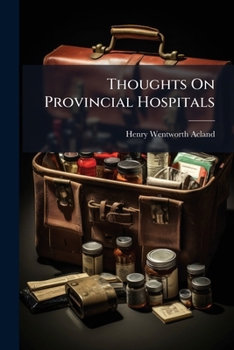
Thoughts On Provincial Hospitals: With Special Reference To Oxford: Together With A Letter To The Very Rev. The Dean Of Christ Church And Other Papers

"Thoughts On Provincial Hospitals," with Special Reference to Oxford, is a compelling historical document by Henry Wentworth Acland. This volume includes Acland's detailed observations and proposals concerning the administration and improvement of provincial hospitals, emphasizing the specific context of Oxford. The work also features Acland's correspondence, including a significant letter to the Dean of Christ Church, further elucidating his perspectives on medical institutions and their vital role within the community.
Acland's insights provide a valuable window into 19th-century medical practices and the evolving landscape of healthcare. This book is essential for historians of medicine, scholars interested in the development of hospital systems, and anyone intrigued by the intersection of medical care and social reform in Victorian England. "Thoughts On Provincial Hospitals" offers a unique blend of historical analysis and practical recommendations, making it a relevant read for understanding the foundations of modern healthcare.
This work has been selected by scholars as being culturally important, and is part of the knowledge base of civilization as we know it. This work was reproduced from the original artifact, and remains as true to the original work as possible. Therefore, you will see the original copyright references, library stamps (as most of these works have been housed in our most important libraries around the world), and other notations in the work.
This work is in the public domain in the United States of America, and possibly other nations. Within the United States, you may freely copy and distribute this work, as no entity (individual or corporate) has a copyright on the body of the work.
As a reproduction of a historical artifact, this work may contain missing or blurred pages, poor pictures, errant marks, etc. Scholars believe, and we concur, that this work is important enough to be preserved, reproduced, and made generally available to the public. We appreciate your support of the preservation process, and thank you for being an important part of keeping this knowledge alive and relevant.
Customer Reviews
ThriftBooks® and the ThriftBooks® logo are registered trademarks of Thrift Books Global, LLC
