


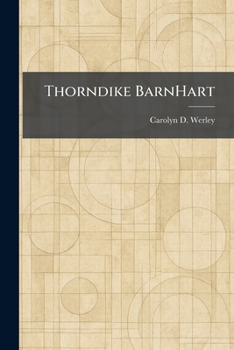
Thorndike BarnHart

Select Format
Select Condition 
Book Overview
"Thorndike Barnhart" represents a significant milestone in the evolution of educational reference materials and lexicography. Developed with a focus on pedagogical efficiency and linguistic clarity, this work centers on providing accessible language tools for students and educators alike.
By applying psychological principles to the compilation of word lists and definitions, the work aims to streamline the process of vocabulary acquisition and reading comprehension. This volume serves as an essential resource for those interested in the history of language instruction, offering a structured approach to understanding the English lexicon through the lens of early 20th-century educational theory. Its emphasis on clarity and frequency of use makes it a valuable study of how dictionary-making transitioned into a science-backed educational endeavor. As a foundational text in the development of modern reference books, it highlights the intersection of education and language science.
This work has been selected by scholars as being culturally important, and is part of the knowledge base of civilization as we know it. This work was reproduced from the original artifact, and remains as true to the original work as possible. Therefore, you may see the original copyright references, library stamps (as most of these works have been housed in our most important libraries around the world), and other notations in the work.
This work is in the public domain in the United States of America, and possibly other nations. Within the United States, you may freely copy and distribute this work, as no entity (individual or corporate) has a copyright on the body of the work.
As a reproduction of a historical artifact, this work may contain missing or blurred pages, poor pictures, errant marks, etc. Scholars believe, and we concur, that this work is important enough to be preserved, reproduced, and made generally available to the public. We appreciate your support of the preservation process, and thank you for being an important part of keeping this knowledge alive and relevant.
Customer Reviews
ThriftBooks ® and the ThriftBooks ® logo are registered trademarks of Thrift Books Global, LLC
