


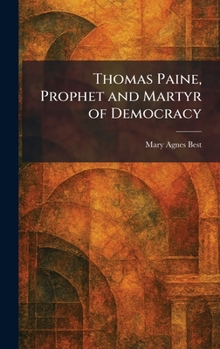
Thomas Paine, Prophet and Martyr of Democracy

"Thomas Paine, Prophet and Martyr of Democracy" offers a compelling and comprehensive exploration of the life of one of the most influential figures of the Enlightenment and the American Revolution. Mary Agnes Best presents an insightful biography that traces Paine's journey from his humble beginnings in England to his pivotal role as a firebrand for liberty in both the United States and France.
This work examines the profound impact of Paine's seminal writings, including "Common Sense" and "The Rights of Man," which challenged monarchical rule and championed the cause of popular sovereignty. Best illustrates how Paine's unwavering commitment to democratic principles often led to personal hardship and social ostracization, earning him the title of a "martyr" for his beliefs. The narrative delves into his complex relationships with other Founding Fathers and his tireless advocacy for human rights, reason, and social justice.
By highlighting his contributions to political thought and his revolutionary spirit, "Thomas Paine, Prophet and Martyr of Democracy" underscores the enduring relevance of Paine's vision. It serves as an essential resource for those interested in the history of democracy, political philosophy, and the turbulent era of the 18th-century revolutions.
This work has been selected by scholars as being culturally important, and is part of the knowledge base of civilization as we know it. This work was reproduced from the original artifact, and remains as true to the original work as possible. Therefore, you may see the original copyright references, library stamps (as most of these works have been housed in our most important libraries around the world), and other notations in the work.
This work is in the public domain in the United States of America, and possibly other nations. Within the United States, you may freely copy and distribute this work, as no entity (individual or corporate) has a copyright on the body of the work.
As a reproduction of a historical artifact, this work may contain missing or blurred pages, poor pictures, errant marks, etc. Scholars believe, and we concur, that this work is important enough to be preserved, reproduced, and made generally available to the public. We appreciate your support of the preservation process, and thank you for being an important part of keeping this knowledge alive and relevant.
Customer Reviews
ThriftBooks ® and the ThriftBooks ® logo are registered trademarks of Thrift Books Global, LLC
