


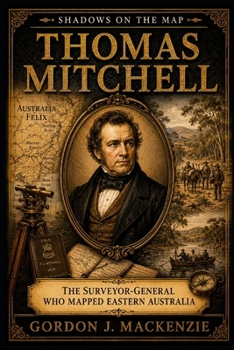
Thomas Mitchell: Surveyor-General and the Making of Eastern Australia

Previously published as Thomas Mitchell by Gordon J. MacKenzie.
Thomas Livingstone Mitchell was a soldier, surveyor, explorer and administrator whose lines helped reshape eastern Australia.
Trained as a military topographer during the Peninsular War, Mitchell arrived in New South Wales in 1827 and quickly rose to become Surveyor-General. He inherited a chaotic land system and set about imposing order through triangulation, county boundaries, roads, bridges and maps. His technical standards helped make colonial government more effective, but the same machinery also strengthened Britain's occupation of Aboriginal Country.
Mitchell's ambitions soon carried him beyond the settled districts.
Across four major expeditions he travelled the Bogan, Darling, Murray and the tropical interior, attempting to resolve geographical mysteries that had frustrated earlier explorers. His 1836 journey produced both the celebrated vision of Australia Felix and the darkest episode of his career: the killings at Mount Dispersion, where his decision to arrange an ambush became part of the violent history of colonial expansion.
Fame followed. So did controversy.
Mitchell fought governors over authority, defended the independence of his Survey Department, published influential expedition narratives, pursued inventions, quarrelled publicly with rivals and even fought a duel. By the 1850s, the institution he had dominated for decades was under formal investigation.
Thomas Mitchell: The Surveyor-General Who Mapped Eastern Australia examines the achievements and contradictions of one of colonial Australia's most formidable public figures: a gifted map-maker whose work helped create roads, boundaries and geographical knowledge that endured, while advancing an imperial system built upon occupation and dispossession.
It is the story of the man who drew lines across a continent - and of what followed when those lines became power.
Customer Reviews
ThriftBooks ® and the ThriftBooks ® logo are registered trademarks of Thrift Books Global, LLC
