


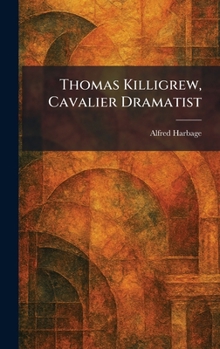
Thomas Killigrew, Cavalier Dramatist

"Thomas Killigrew, Cavalier Dramatist, 1612-83" offers a comprehensive biographical and critical study of one of the most fascinating figures of the Stuart court and the Restoration stage. As a playwright, courtier, and manager of the King's Company, Thomas Killigrew played a central role in the cultural life of 17th-century England. This work by Alfred Harbage meticulously traces Killigrew's life from his early years as a page to King Charles I through his years of exile and his eventual rise as a dominant force in the London theatre scene.
The study provides an insightful analysis of Killigrew's dramatic works, including "The Parson's Wedding", and situates his writing within the broader context of the Cavalier tradition. Harbage examines the intersection of Killigrew's literary career with his political loyalties, illustrating how his experiences as a royalist shaped his creative output. Beyond the individual, the book serves as a valuable exploration of the evolution of English drama during a period of profound political upheaval and renewal. Readers interested in theatre history, the Restoration era, and the lives of English dramatists will find this an essential resource that illuminates the legacy of a man who helped bridge the gap between the Elizabethan heritage and the modern stage.
This work has been selected by scholars as being culturally important, and is part of the knowledge base of civilization as we know it. This work was reproduced from the original artifact, and remains as true to the original work as possible. Therefore, you may see the original copyright references, library stamps (as most of these works have been housed in our most important libraries around the world), and other notations in the work.
This work is in the public domain in the United States of America, and possibly other nations. Within the United States, you may freely copy and distribute this work, as no entity (individual or corporate) has a copyright on the body of the work.
As a reproduction of a historical artifact, this work may contain missing or blurred pages, poor pictures, errant marks, etc. Scholars believe, and we concur, that this work is important enough to be preserved, reproduced, and made generally available to the public. We appreciate your support of the preservation process, and thank you for being an important part of keeping this knowledge alive and relevant.
Customer Reviews
ThriftBooks ® and the ThriftBooks ® logo are registered trademarks of Thrift Books Global, LLC
