


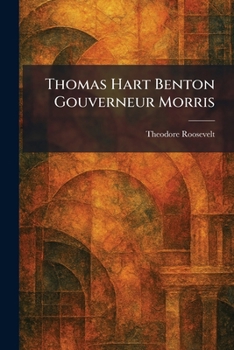
Thomas Hart Benton Gouverneur Morris

In "Thomas Hart Benton Gouverneur Morris", Theodore Roosevelt provides a compelling analysis of two influential figures who played crucial roles in the development of the American political landscape. This biographical work explores the lives and legacies of Thomas Hart Benton, the long-serving Missouri senator known for his advocacy of westward expansion, and Gouverneur Morris, the statesman and diplomat who was instrumental in drafting the United States Constitution.
Roosevelt examines these figures not only as individuals but as representatives of the diverse political currents of their time. Through Benton, readers gain insight into the Jacksonian era and the tensions surrounding the growth of the young nation. With Morris, the focus shifts to the intellectual foundations of the republic and the complexities of international diplomacy during the revolutionary period. Written with Roosevelt's characteristic vigor and appreciation for historical consequence, this volume offers a profound look at the leadership, statesmanship, and ideological conflicts that defined the early United States. "Thomas Hart Benton Gouverneur Morris" remains an essential read for those interested in American history and the evolution of its democratic institutions.
This work has been selected by scholars as being culturally important, and is part of the knowledge base of civilization as we know it. This work was reproduced from the original artifact, and remains as true to the original work as possible. Therefore, you may see the original copyright references, library stamps (as most of these works have been housed in our most important libraries around the world), and other notations in the work.
This work is in the public domain in the United States of America, and possibly other nations. Within the United States, you may freely copy and distribute this work, as no entity (individual or corporate) has a copyright on the body of the work.
As a reproduction of a historical artifact, this work may contain missing or blurred pages, poor pictures, errant marks, etc. Scholars believe, and we concur, that this work is important enough to be preserved, reproduced, and made generally available to the public. We appreciate your support of the preservation process, and thank you for being an important part of keeping this knowledge alive and relevant.
Customer Reviews
ThriftBooks ® and the ThriftBooks ® logo are registered trademarks of Thrift Books Global, LLC
