


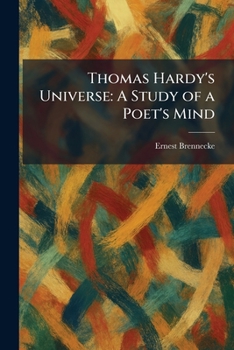
Thomas Hardy's Universe: A Study of a Poet's Mind

Select Format
Select Condition 
Book Overview
"Thomas Hardy's Universe: A Study of a Poet's Mind" is an insightful critical examination of the philosophical and intellectual underpinnings that define the works of one of England's most celebrated literary figures. Ernest Brennecke delves deep into the universe created by Thomas Hardy, exploring the complex interplay between the author's poetic vision and his overarching worldview. The study meticulously analyzes Hardy's concepts of fate, nature, and the human condition, providing readers with a comprehensive understanding of the metaphysical foundations that support both his prose and his poetry.
Through a scholarly yet accessible lens, this work situates Hardy's creative output within the broader context of nineteenth-century thought, tracing the influences of contemporary science and philosophy on his artistic development. Brennecke offers a thematic exploration of Hardy's recurring motifs, shedding light on the somber beauty and the profound skepticism that characterize his literary legacy. This book serves as an essential companion for students of Victorian literature, offering a nuanced perspective on the poet's mind that transformed the landscapes of Wessex into a stage for universal human struggle. It remains a valuable resource for anyone seeking to grasp the intellectual depth behind the enduring power of Thomas Hardy's writing.
This work has been selected by scholars as being culturally important, and is part of the knowledge base of civilization as we know it. This work was reproduced from the original artifact, and remains as true to the original work as possible. Therefore, you may see the original copyright references, library stamps (as most of these works have been housed in our most important libraries around the world), and other notations in the work.
This work is in the public domain in the United States of America, and possibly other nations. Within the United States, you may freely copy and distribute this work, as no entity (individual or corporate) has a copyright on the body of the work.
As a reproduction of a historical artifact, this work may contain missing or blurred pages, poor pictures, errant marks, etc. Scholars believe, and we concur, that this work is important enough to be preserved, reproduced, and made generally available to the public. We appreciate your support of the preservation process, and thank you for being an important part of keeping this knowledge alive and relevant.
Customer Reviews
ThriftBooks ® and the ThriftBooks ® logo are registered trademarks of Thrift Books Global, LLC
