


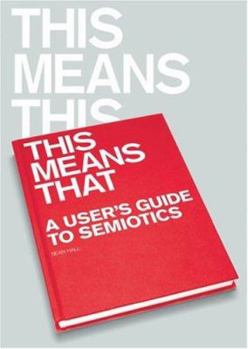
This Means This, This Means That: A User's Guide to Semiotics

Select Format
Select Condition 
Book Overview
Semiotics is the theory of signs. Signs are amazingly diverse: from simple road signs that point to a destination, to smoke that warns us of fire, to the culturally-conditioned symbols buried within art and literature. Our reading of signs is very much a part of everyday life. Yet semiotics is often perceived as a mysterious science. This introductory book decodes themystery of semiotics using visual examples instead of abstract theory. Divided into 75 key semiotic concepts, each section of the book begins with a single image or sign, accompanied by a question that invites us to interpret what we are seeing. Turning the page, we can compare our response with the theory behind the sign. In this way, we actively engage in creative thinking. Read straight through or dipped into regularly, thisbook provides practical examples of how meaning is made in contemporary culture.
Format:Paperback
Language:English
ISBN:1856695212
ISBN13:9781856695213
Release Date:October 2007
Publisher:Laurence King Publishing
Length:176 Pages
Weight:1.56 lbs.
Dimensions:10.3" x 0.6" x 7.4"
Grade Range:Grade 8 to Postsecondary
Customer Reviews
4 ratings
worthy semiotics guide + pictures
Published by Thriftbooks.com User , 16 years ago
great book-very helpful through examples and simple, logical layout. great for information design introduction & fosters exploration.
Colorful & Insightful
Published by Thriftbooks.com User , 16 years ago
Sean Hall did a good job of choosing images for the book's content. Every other page has a good quality image on it & I was very surprised at how well made this book is. The pages are thick and sturdy, with a nice finish. There are new vocab words to learn nearly every other page. It's full of useful information, especially for anyone writing about semiotics.
'This and that' that works
Published by Thriftbooks.com User , 17 years ago
The main point is no matter what we think when facing a number of blueprints here - every example somehow leads us to a fine conclusion. The author dares us to think before seeing his opinion, conclude and then compare our vision of things to his own - at its worst we challenge ourselves; are we smart or are we dumb? How deep do we really get into specific subject matters, especially when questions in this book somehow insist on our momentary impressions? Or are we just passively accepting others' ways of seeing things? Everything means something, and this book makes it a fine study on visual culture, also focusing on a certain problem of how much this visual culture is actually neglected these days. Simple to read, fun to analyze, visual lessons that help directing individual choices towards proper perspective of things.
Fun, intelligent and not alienated...
Published by Thriftbooks.com User , 17 years ago
I live in a photographic world: teach photography in the main art school in my city, work as a photo curator since God knows when, etc. And I have seen with horror how semiotics have become, starting from being a sistem of analisis to be the object of study instead of what it was analyzing in the begining. When that happens in photo, the ones first fascinated by the laws and the names -triad, Pearce- ended totally alienated incapable of producing just one single image... equivalent to blind, imagination and freedom totally out of the equation. Yes I declare myself 'anti-semiotic'.And then I found this surprising book. It si fun to read, with just the exact level of semiotic a creative, a student of comunication or a young artist would want: how we represent and read, how the meaning is constructed.... but always keeping in mind that the important part is the message not is structure, what we see, not empty laws about the sign... Really a must in the classroom, it is far from the semiotic dogma, and close to !creativity!!!! Far form a text made of full academic notes, it is one page image and a question, the next the explanation and more examples, more image than any other thing.
Copyright © 2026 Thriftbooks.com Terms of Use
| Privacy Policy | Do Not
Sell/Share My Personal Information | Cookie Policy | Cookie Preferences | Accessibility Statement
ThriftBooks® and the ThriftBooks® logo are registered trademarks of Thrift Books Global, LLC
ThriftBooks® and the ThriftBooks® logo are registered trademarks of Thrift Books Global, LLC
