


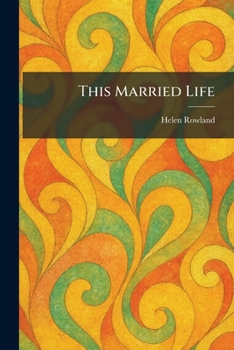
This Married Life

Select Format
Select Condition 
Book Overview
"This Married Life" is a sparkling collection of humorous insights and witty observations by the celebrated American columnist Helen Rowland. Renowned for her sharp tongue and keen eye for the complexities of domestic harmony, Rowland explores the triumphs, tribulations, and absurdities inherent in the state of matrimony. Through a series of playful dialogues and clever vignettes, the work captures the daily dance between husband and wife, offering a satirical yet affectionate look at the compromises and misunderstandings that define a shared life.
Rowland's writing, which gained immense popularity in the early 20th century, remains remarkably relevant today. She skillfully dissects the traditional roles of men and women, delivering a wealth of aphorisms and "Rowlandisms" that challenge societal expectations with a wink and a smile. From the honeymoon phase to the comfortable routine of long-term partnership, "This Married Life" serves as a timeless mirror to the human heart. It is an essential read for anyone who appreciates sophisticated humor, historical perspectives on relationships, or the enduring charm of social satire.
This work has been selected by scholars as being culturally important, and is part of the knowledge base of civilization as we know it. This work was reproduced from the original artifact, and remains as true to the original work as possible. Therefore, you may see the original copyright references, library stamps (as most of these works have been housed in our most important libraries around the world), and other notations in the work.
This work is in the public domain in the United States of America, and possibly other nations. Within the United States, you may freely copy and distribute this work, as no entity (individual or corporate) has a copyright on the body of the work.
As a reproduction of a historical artifact, this work may contain missing or blurred pages, poor pictures, errant marks, etc. Scholars believe, and we concur, that this work is important enough to be preserved, reproduced, and made generally available to the public. We appreciate your support of the preservation process, and thank you for being an important part of keeping this knowledge alive and relevant.
Customer Reviews
ThriftBooks ® and the ThriftBooks ® logo are registered trademarks of Thrift Books Global, LLC
