


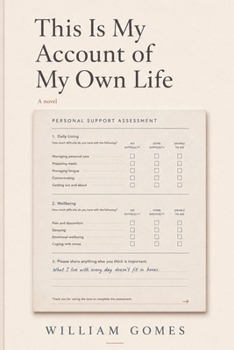
This Is My Account of My Own Life

A powerful contemporary literary novel about disability, dignity, bureaucracy, state failure, family love and the struggle to make a human life heard beyond the boxes of a form.
Mara Ellison knows the sound of a brown envelope.
When a reassessment letter arrives from Larkfield Service Centre, she is asked once again to prove the life she already lives: the pain that travels through her body, the fatigue that rearranges the day, the mobility problems, the damp flat, the careful lists, the evidence, the deadlines, the phone calls and the quiet fear that a payment may disappear because a document has not been seen by the right person at the right time.
Her daughter Leanne, working nights in a warehouse, tries to hold together the practical world: copies, forms, appointments, bus fares, phone calls, food, electricity, and the fierce love that often comes out sounding like argument. Around them are advice workers, call handlers, assessment reports, missing evidence, internal reviews, official scripts and people whose lives are reduced to words such as "entitlement", "evidence", "decision" and "failure to respond".
As Mara's own account moves through the system, another story begins to emerge inside the offices that judge her. Nina Walsh, a quality reviewer at the Service Centre, notices troubling patterns in how vulnerable lives are handled, recorded, misunderstood and closed. What begins as paperwork becomes a question of conscience.
Written with compassion, restraint and moral clarity, This Is My Account of My Own Life is a deeply humane work of contemporary British literary fiction about disability, poverty, welfare bureaucracy, family care, working-class survival, institutional failure and the insistence that a life is more than a file.
For readers of serious literary fiction, social justice fiction, disability fiction, state-of-Britain novels and stories about ordinary people facing extraordinary systems, this is a moving novel about what happens when pain must be translated into evidence before help can arrive.
A haunting and compassionate novel about forms, files, family, dignity and the right to give an account of one's own life.
Customer Reviews
ThriftBooks ® and the ThriftBooks ® logo are registered trademarks of Thrift Books Global, LLC
