


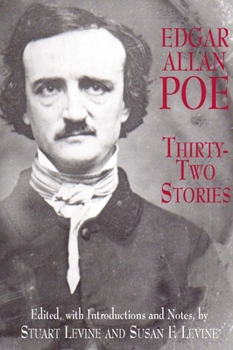
Thirty-Two Stories (Poe) (Hackett Publishing Co.)

Select Format
Select Condition 
Book Overview
America's most influential literary figure worldwide is familiar to most readers of short fiction through only about a dozen stories. This is because many of Poe's tales depend on knowledge a reader... This description may be from another edition of this product.
Format:Paperback
Language:English
ISBN:0872204987
ISBN13:9780872204980
Release Date:March 2000
Publisher:Hackett Publishing Company, Inc.
Length:390 Pages
Weight:1.21 lbs.
Dimensions:8.8" x 1.0" x 6.0"
Customer Reviews
1 rating
Tales of terror
Published by Thriftbooks.com User , 18 years ago
I've always had a liking for Edgar Allan Poe, with his tales of horror, mystery and suspense, done in the atmospheric prose of a master writer. Since I live close enough, I've even made some trips to his gravesite, a place that is always surrounded by a sense of sadness. Poe was a tormented genius who died young, under mysterious circumstances, and wasn't deservingly popular -- presumably because his writing explored the darkness of the human heart, love, satire, and the earliest whodunnit stories. And the simply titled "Thirty-Two Stories" contains his magnificent prose, from tales of ghastly madness to bloodstained fairy tales. Poe's fiction writings include short stories and novellas, which tend to be rather weird at the very least -- a treasure-hunt and a golden insect, a woman's rebirth into ANOTHER woman, a jester's revenge, a ship caught in a whirlpool, a bizarre obsession with an unknown Londoner, and even a journalistic hoax that Poe spun up about a flying machine. He even wrote some outright funny stories, like the quirky "Literary Life of Thingum Bob, Esq." and the satirical ballooning story "Mellonta Tauta." And, of course, the horror -- this is what Poe is best known for. He spun some truly ghastly stories: a giant black cat haunts a vicious alcoholic, a murder in catacombs, a duke tries to lock out a plague only to have his party crashed by a ghastly red specter, a man is slowly driven to a deadly pit by a sharp pendulum, while a murderer is slowly driven mad by the sound of his victim's beating heart under the floor. But the most striking of these is "Fall of the House of Usher," a haunting, horrific story about a bizarre, crumbling house that seems to have its own soul, and the equally haunted Usher siblings. This is possibly Poe's most peerless work, his most strikingly symbolic and subtle, and a prime example of Gothic literature at its finest. And there is also two of his Monsieur C. Auguste Dupin stories, which were the first to feature a brilliant detective solving an impossible crime -- yes, even before Sherlock Holmes. For some reason the second isn't included here, but the first and third are, with Dupin solving -- using "ratiocination," or logical thought -- a bizarre pair of murders and the location of an indiscreet leter. It's not a good idea to read these various stories all at once. It's too intense. It's better to soak it in a little at a time, so that you can get a better feel for the different kinds of writing that Poe did, and how he excelled at pretty much everything he put down on paper. Most writers -- even magnificent ones -- can't boast of that much. And Poe's writing is what makes even his least story or poem come alive -- he brought a gothic, misty vibrancy to his stories. He could spin up walled-up chambers, bloody murders, castles, and old crumbly mansions, and fill them with horrors that other authors couldn't manage without seeming silly. It's not hard to see why he was an influence on authors
Copyright © 2026 Thriftbooks.com
Terms of Use | Privacy Policy | Do Not Sell/Share My Personal Information | Cookie Policy | Cookie Preferences | Accessibility Statement
ThriftBooks ® and the ThriftBooks ® logo are registered trademarks of Thrift Books Global, LLC
ThriftBooks ® and the ThriftBooks ® logo are registered trademarks of Thrift Books Global, LLC
