


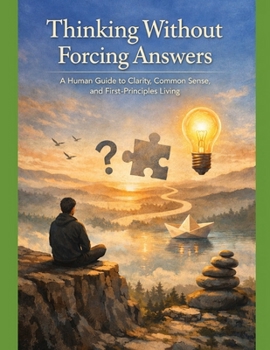
Thinking Without Forcing Answers: A Human Guide to Clarity, Common Sense, and First-Principles Living

Thinking Without Forcing Answers is a reflective nonfiction book about how ordinary thinking quietly breaks - and how it begins to heal when we stop rushing it.
Rather than offering methods, frameworks, or solutions, this book observes the moments where certainty arrives too early, where familiarity replaces understanding, and where action becomes performance instead of progress. Through conversations, small decisions, and lived situations, it explores how good intentions distort reasoning, why busyness feels comforting, and how clarity often appears only after we stop demanding it.
Written in a personal, narrative voice, the book does not teach thinking as a skill to master, but treats it as a daily practice - one shaped by attention, restraint, and honesty. It invites readers to sit with unanswered questions, notice what they are protecting, and allow understanding to arrive quietly, without announcement.
This is not a guide to becoming smarter.
It is an invitation to think less forcefully - and live with fewer, truer answers.
Customer Reviews
ThriftBooks® and the ThriftBooks® logo are registered trademarks of Thrift Books Global, LLC
