


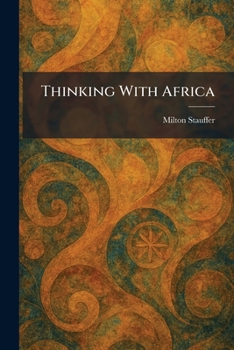
Thinking With Africa

Select Format
Select Condition 
Book Overview
"Thinking With Africa" is a significant collection of essays and reflections that explores the intersection of Christian missionary work and African social and cultural life during the early twentieth century. Edited by Milton Stauffer, this volume seeks to foster a deeper understanding between the West and Africa by presenting the perspectives of those intimately involved in the continent's religious and social development.
The work moves beyond traditional missionary narratives to engage with the complexities of indigenous leadership, the preservation of African cultural values, and the challenges of establishing a self-governing and self-supporting African church. It emphasizes a collaborative approach to faith, advocating for a paradigm of 'thinking with' rather than 'thinking for' the people of Africa. By documenting the aspirations and spiritual insights of local communities and foreign observers alike, the text offers a nuanced look at the evolving landscape of global Christianity.
As a historical resource, "Thinking With Africa" provides invaluable context for the study of missiology, African history, and cross-cultural theology. It serves as a testament to the early efforts toward inter-racial cooperation and religious dialogue, highlighting the enduring struggle to reconcile Western theological traditions with African realities.
This work has been selected by scholars as being culturally important, and is part of the knowledge base of civilization as we know it. This work was reproduced from the original artifact, and remains as true to the original work as possible. Therefore, you may see the original copyright references, library stamps (as most of these works have been housed in our most important libraries around the world), and other notations in the work.
This work is in the public domain in the United States of America, and possibly other nations. Within the United States, you may freely copy and distribute this work, as no entity (individual or corporate) has a copyright on the body of the work.
As a reproduction of a historical artifact, this work may contain missing or blurred pages, poor pictures, errant marks, etc. Scholars believe, and we concur, that this work is important enough to be preserved, reproduced, and made generally available to the public. We appreciate your support of the preservation process, and thank you for being an important part of keeping this knowledge alive and relevant.
Customer Reviews
ThriftBooks ® and the ThriftBooks ® logo are registered trademarks of Thrift Books Global, LLC
