


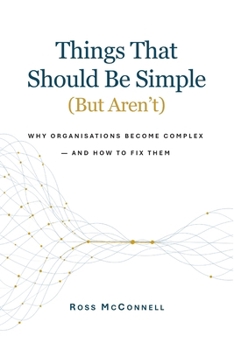
Things That Should Be Simple (But Aren't): Why organisations become complex - and how to fix them

Across every organisation, there are things that should be simple.
But somehow, they aren't.
Processes become harder to follow. Decisions take longer than they should. Systems designed to create clarity begin to create confusion instead. And over time, complexity starts to feel inevitable - just part of how things are.
But it isn't.
This book explores why complexity emerges, even in well-intentioned organisations - and why the more we try to control it, the worse it often becomes.
Rather than offering quick fixes or frameworks, Things That Should Be Simple (But Aren't) takes a step back to examine the patterns beneath the surface:
Why systems that look structured often behave unpredictablyHow small misalignments quietly compound into large problemsWhy people, process, and culture cannot be separatedHow language, perception, and feedback shape outcomesAnd what changes when you begin to see the system as a wholeAs the book unfolds, complexity starts to make sense.
Not as something to eliminate entirely, but as something that can be understood - and, with the right perspective, simplified.
This is not a book about adding more.
It's about seeing more clearly.
For leaders, operators, and anyone responsible for making things work -
this book offers a different way to think about complexity,
and a clearer path toward making things simple again.
Customer Reviews
ThriftBooks ® and the ThriftBooks ® logo are registered trademarks of Thrift Books Global, LLC
