


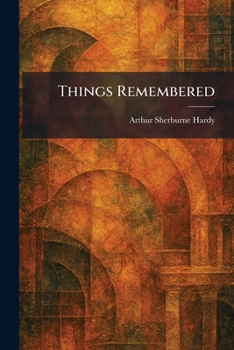
Things Remembered

"Things Remembered" is a compelling and thoughtful memoir by Arthur Sherburne Hardy, an American diplomat, mathematician, and novelist whose life spanned the transition into the modern era. In this collection of reminiscences, Hardy provides a sophisticated look at a life spent in the service of both academia and the state. As a former U.S. Minister to several countries, including Spain, Switzerland, and Greece, Hardy offers unique perspectives on the geopolitical climate of the late 19th and early 20th centuries.
Beyond his diplomatic career, the work delves into his intellectual pursuits and his interactions with the leading literary and scientific figures of his day. The narrative is characterized by an elegant prose style that reflects Hardy's dual expertise as a technical writer and a creator of fiction. "Things Remembered" captures the essence of a bygone era, offering readers intimate sketches of travel, the nuances of international statecraft, and the personal reflections of a man who witnessed history from the inside. This work stands as a valuable historical and literary document, providing insight into the character and experiences of one of America's most versatile public figures.
This work has been selected by scholars as being culturally important, and is part of the knowledge base of civilization as we know it. This work was reproduced from the original artifact, and remains as true to the original work as possible. Therefore, you may see the original copyright references, library stamps (as most of these works have been housed in our most important libraries around the world), and other notations in the work.
This work is in the public domain in the United States of America, and possibly other nations. Within the United States, you may freely copy and distribute this work, as no entity (individual or corporate) has a copyright on the body of the work.
As a reproduction of a historical artifact, this work may contain missing or blurred pages, poor pictures, errant marks, etc. Scholars believe, and we concur, that this work is important enough to be preserved, reproduced, and made generally available to the public. We appreciate your support of the preservation process, and thank you for being an important part of keeping this knowledge alive and relevant.
Customer Reviews
ThriftBooks ® and the ThriftBooks ® logo are registered trademarks of Thrift Books Global, LLC
