


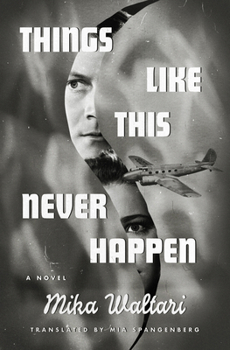
Things Like This Never Happen

The man knows war is coming--there is talk in the papers of political unrest coming to a head-- but the plane has been given clearance for takeoff. He has an extensive memo in his briefcase dealing with Greece's imports and exports, the country's need for wood, and the measurements used there. Leaving behind the remains of a wasted life--a loveless marriage, a lost child--he sets off, hurtling south, with an immense feeling of peace. It is March 1939.
When stormy weather forces the plane to attempt a landing in unfamiliar territory, they face gunfire from the ground and are shot down. The man and a fellow female passenger are the lone survivors of the crash. Surrounded by mountains and the blossoms of spring, they embark on a journey, across an unknown land and language--encoutering a circus troupe, a band of soldiers, a surreal m lange of people and place--toward uncertain salvation, as life as they have known it falls away and the continent is engulfed in war.
One of the best known figures of Finnish literature, Mika Waltari wrote Things Like This Never Happen in 1939 under the pseudonym Leo Arne, though it was not published until 1944. Translated into English for the first time, Things Like This Never Happen is an existential classic that belongs beside Albert Camus's The Stranger or Franz Kafka's The Trial, remaining vital for its presentation of the impossibility of moral certainty in the face of war, betrayal, and violence.
Customer Reviews
ThriftBooks ® and the ThriftBooks ® logo are registered trademarks of Thrift Books Global, LLC
