


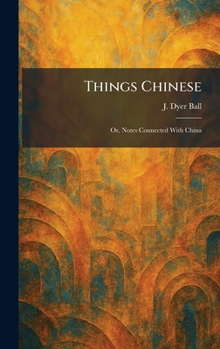
Things Chinese: Or, Notes Connected With China

"Things Chinese: Or, Notes Connected With China" is a comprehensive and scholarly compendium that offers an intricate look at the multifaceted world of China at the turn of the 20th century. Written by J. Dyer Ball, a noted Sinologist who spent decades living in the region, this work serves as an invaluable reference for understanding the social, political, and cultural landscape of the era.
The text covers a vast array of subjects, ranging from religious practices and philosophical movements to everyday customs, language, and trade. Arranged in an accessible, encyclopedic format, the book provides readers with detailed insights into everything from tea production and porcelain to the intricacies of government and the nuances of Chinese etiquette. It captures a pivotal moment in history, documenting traditional ways of life alongside the significant changes occurring within the country during this period.
This work remains a significant resource for historians, sociologists, and anyone interested in the rich heritage of East Asia. By providing a window into the complexities of Chinese society as seen through the eyes of a dedicated observer, it remains an essential read for those seeking a deeper understanding of the traditions that have shaped one of the world's oldest continuous civilizations.
This work has been selected by scholars as being culturally important, and is part of the knowledge base of civilization as we know it. This work was reproduced from the original artifact, and remains as true to the original work as possible. Therefore, you may see the original copyright references, library stamps (as most of these works have been housed in our most important libraries around the world), and other notations in the work.
This work is in the public domain in the United States of America, and possibly other nations. Within the United States, you may freely copy and distribute this work, as no entity (individual or corporate) has a copyright on the body of the work.
As a reproduction of a historical artifact, this work may contain missing or blurred pages, poor pictures, errant marks, etc. Scholars believe, and we concur, that this work is important enough to be preserved, reproduced, and made generally available to the public. We appreciate your support of the preservation process, and thank you for being an important part of keeping this knowledge alive and relevant.
Customer Reviews
ThriftBooks ® and the ThriftBooks ® logo are registered trademarks of Thrift Books Global, LLC
