


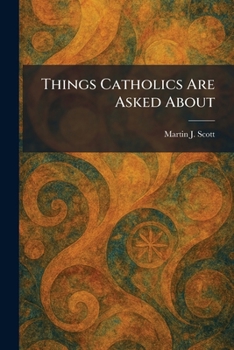
Things Catholics Are Asked About

"Things Catholics Are Asked About" is a comprehensive guide designed to address the most common questions and misconceptions surrounding the Catholic faith. Written by the prominent Jesuit apologist Martin J. Scott, this work serves as a practical manual for both Catholics seeking to articulate their beliefs and non-Catholics looking for clarity on Church teachings and practices.
The book covers a wide array of topics, including the authority of the Pope, the nature of the sacraments, the role of Mary and the saints, and the Catholic perspective on various social and moral issues. Scott employs a clear, conversational, and persuasive style, making complex theological concepts accessible to the layperson. By providing logical explanations and scriptural foundations for Catholic traditions, the work remains an insightful resource for understanding the instructional literature of the early 20th-century American Church.
Emphasizing the harmony between faith and reason, "Things Catholics Are Asked About" offers a spirited defense of the religious tenets that define Catholic life. It stands as a testament to the era of Catholic apologetics, providing readers with a historical perspective on how the faith was explained and defended in a modernizing world.
This work has been selected by scholars as being culturally important, and is part of the knowledge base of civilization as we know it. This work was reproduced from the original artifact, and remains as true to the original work as possible. Therefore, you may see the original copyright references, library stamps (as most of these works have been housed in our most important libraries around the world), and other notations in the work.
This work is in the public domain in the United States of America, and possibly other nations. Within the United States, you may freely copy and distribute this work, as no entity (individual or corporate) has a copyright on the body of the work.
As a reproduction of a historical artifact, this work may contain missing or blurred pages, poor pictures, errant marks, etc. Scholars believe, and we concur, that this work is important enough to be preserved, reproduced, and made generally available to the public. We appreciate your support of the preservation process, and thank you for being an important part of keeping this knowledge alive and relevant.
Customer Reviews
ThriftBooks ® and the ThriftBooks ® logo are registered trademarks of Thrift Books Global, LLC
