


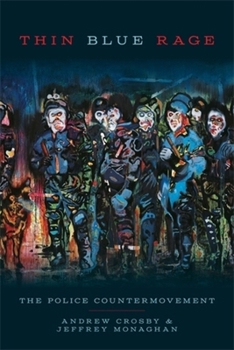
Thin Blue Rage: The Police Countermovement
No Customer Reviews

Policing agencies in Canada continue to face criticism over their outsized use of violence in response to encampments of unhoused people, protests against police brutality, and sites of environmental activism and Indigenous land defence. Feeling victimized and misunderstood, police officers increasingly sport harmful "thin blue line" symbology depicting their role as guardians of civilization against disorder -- with poor, racialized, and progressive people squarely on the wrong side.
With meticulous historical, theoretical, and empirical detail, this deeply researched text recasts police as a social movement-in-power rather than a neutral public institution. It explores key debates in policing literature alongside contemporary examples of policing's ideological dimensions, including communications practices, membership structures, and political campaigning. Linking police identity with far-right perceptions of victimhood and alienation, Thin Blue Rage analyzes police's defensive anger towards a public they see as not understanding or supporting how they function.Format:Paperback
Language:English
ISBN:1773638084
ISBN13:9781773638089
Release Date:May 2026
Publisher:Fernwood Publishing
Length:208 Pages
Weight:0.66 lbs.
Dimensions:0.8" x 6.0" x 8.9"
Customer Reviews
0 rating
Copyright © 2026 Thriftbooks.com
Terms of Use | Privacy Policy | Do Not Sell/Share My Personal Information | Cookie Policy | Cookie Preferences | Accessibility Statement
ThriftBooks ® and the ThriftBooks ® logo are registered trademarks of Thrift Books Global, LLC
ThriftBooks ® and the ThriftBooks ® logo are registered trademarks of Thrift Books Global, LLC
