


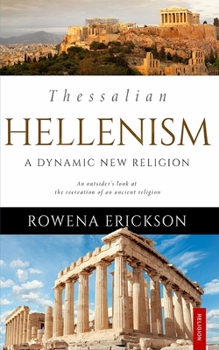
Thessalian Hellenism: A Dynamic New Religion
No Customer Reviews

Thessalian Hellenism can best be described as philosophical in its spiritual orientation, theurgic (mystical) in its religious practices and Neoplatonic in the focus of our philosophy. They are Neoplatonic in that they focus on the wisdom portrayed within the dialogues of Plato and the teachings of Plotinus, Proclus, Iamblichus, and other Neoplatonic philosophers. These philosophical texts and ideas, as well as the literary works of Homer, are considered their holy texts. The knowledge and insights gained through the study of these works creates, for them, a continuum of wisdom and practice reaching back to the very foundations of Western civilization and the Western Mystical Traditions.
Their beliefs and practices were born in the streets of ancient Athens with the teachings of Socrates, continued and elaborated upon by Plato in the first Academy and culminated in the Theurgic school of Iamblichus. This tradition has included names of such repute as Aristotle, Plotinus, Porphyry, Julian Augustus, Maximus of Ephesus, Aedisus, Hypatia of Alexandria, Proclus, Plutarch, Iamblichus and so many more. Men and women whose thoughts and ideas survived their own lives and extended even into our own; a tradition of knowledge and practice that has spanned a time frame of well over 2500 years.
They are a community organized as a religious order - a union of individuals constituting both citizens and clergy, gathered for worship, education, and spiritual development. Their religious calendar honors the Dodekatheon (12 gods) of Ancient Greece (Hellas) as well as other ancient Hellenic deities, heroes, and ancestors.
Their beliefs and practices were born in the streets of ancient Athens with the teachings of Socrates, continued and elaborated upon by Plato in the first Academy and culminated in the Theurgic school of Iamblichus. This tradition has included names of such repute as Aristotle, Plotinus, Porphyry, Julian Augustus, Maximus of Ephesus, Aedisus, Hypatia of Alexandria, Proclus, Plutarch, Iamblichus and so many more. Men and women whose thoughts and ideas survived their own lives and extended even into our own; a tradition of knowledge and practice that has spanned a time frame of well over 2500 years.
They are a community organized as a religious order - a union of individuals constituting both citizens and clergy, gathered for worship, education, and spiritual development. Their religious calendar honors the Dodekatheon (12 gods) of Ancient Greece (Hellas) as well as other ancient Hellenic deities, heroes, and ancestors.
Format:Paperback
Language:English
ISBN:B0BB5X71T3
ISBN13:9798847331142
Release Date:August 2022
Publisher:Independently Published
Length:42 Pages
Weight:0.11 lbs.
Dimensions:0.1" x 5.0" x 8.0"
Customer Reviews
0 rating
Copyright © 2026 Thriftbooks.com Terms of Use
| Privacy Policy | Do Not
Sell/Share My Personal Information | Cookie Policy | Cookie Preferences | Accessibility Statement
ThriftBooks® and the ThriftBooks® logo are registered trademarks of Thrift Books Global, LLC
ThriftBooks® and the ThriftBooks® logo are registered trademarks of Thrift Books Global, LLC
