


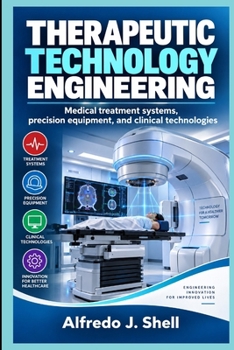
THERAPEUTIC TECHNOLOGY ENGINEERING: Medical treatment systems, precision equipment, and clinical technologies
No Customer Reviews

THERAPEUTIC TECHNOLOGY ENGINEERING provides a structured exploration of the engineering principles behind technologies used to support medical treatment, clinical procedures, therapeutic interventions, and patient care. It examines how precision equipment, sensing systems, control technologies, imaging platforms, software, and medical devices are integrated into modern treatment environments. Therapeutic technologies bring together concepts from biomedical engineering, electrical engineering, mechanical engineering, software development, instrumentation, materials science, and clinical practice. Designing these systems requires careful attention to accuracy, reliability, safety, usability, measurement, control, and the specific requirements of clinical environments. The book explores how medical treatment systems are designed to deliver controlled physical, mechanical, electrical, optical, thermal, or other forms of therapeutic intervention. It examines the engineering components that support treatment delivery, including sensors, actuators, control systems, monitoring equipment, precision mechanisms, software interfaces, and data-processing systems. Particular attention is given to precision and system control. Clinical technologies often require accurate positioning, controlled energy delivery, reliable measurement, continuous monitoring, and appropriate feedback. The book considers how these engineering elements can work together to support repeatable and controlled operation while accounting for system limitations and environmental conditions. Key topics include: * Fundamentals of therapeutic technology engineering
* Medical treatment system architecture
* Clinical engineering principles
* Precision medical equipment
* Therapeutic device design
* Medical sensors and instrumentation
* Measurement and monitoring systems
* Control systems for medical equipment
* Precision positioning technologies
* Actuators and mechanical systems
* Medical imaging and treatment integration
* Software and digital clinical systems
* Human-machine interfaces
* Equipment calibration and verification
* System reliability and maintenance
* Medical device testing and validation
* Risk management and safety engineering
* Clinical technology integration
* Data acquisition and monitoring
* Equipment performance evaluation
* Emerging therapeutic technologies
* Engineering considerations in clinical environments The book also examines the relationship between therapeutic equipment and the broader clinical environment. Medical treatment technologies must interact with healthcare professionals, patients, information systems, monitoring equipment, and supporting infrastructure. Effective engineering therefore involves not only individual device performance but also system integration, usability, reliability, maintenance, and appropriate safety controls. THERAPEUTIC TECHNOLOGY ENGINEERING is intended for biomedical engineering students, clinical engineering students, healthcare technology professionals, medical device developers, engineering learners, technicians, researchers, and readers interested in the technological foundations of modern treatment systems. It provides a broad engineering framework for understanding how precision equipment and clinical technologies are designed, controlled, evaluated, and integrated. Explore the engineering behind modern therapeutic technologies. Scroll up and obtain your copy now to build your understanding of medical treatment systems, precision equipment, clinical technologies, sensors, control systems, and the engineering principles that support their operation.
* Medical treatment system architecture
* Clinical engineering principles
* Precision medical equipment
* Therapeutic device design
* Medical sensors and instrumentation
* Measurement and monitoring systems
* Control systems for medical equipment
* Precision positioning technologies
* Actuators and mechanical systems
* Medical imaging and treatment integration
* Software and digital clinical systems
* Human-machine interfaces
* Equipment calibration and verification
* System reliability and maintenance
* Medical device testing and validation
* Risk management and safety engineering
* Clinical technology integration
* Data acquisition and monitoring
* Equipment performance evaluation
* Emerging therapeutic technologies
* Engineering considerations in clinical environments The book also examines the relationship between therapeutic equipment and the broader clinical environment. Medical treatment technologies must interact with healthcare professionals, patients, information systems, monitoring equipment, and supporting infrastructure. Effective engineering therefore involves not only individual device performance but also system integration, usability, reliability, maintenance, and appropriate safety controls. THERAPEUTIC TECHNOLOGY ENGINEERING is intended for biomedical engineering students, clinical engineering students, healthcare technology professionals, medical device developers, engineering learners, technicians, researchers, and readers interested in the technological foundations of modern treatment systems. It provides a broad engineering framework for understanding how precision equipment and clinical technologies are designed, controlled, evaluated, and integrated. Explore the engineering behind modern therapeutic technologies. Scroll up and obtain your copy now to build your understanding of medical treatment systems, precision equipment, clinical technologies, sensors, control systems, and the engineering principles that support their operation.
Format:Paperback
Language:English
ISBN:B0HKMR5HQK
ISBN13:9798175733328
Release Date:September 2026
Publisher:Independently published
Length:243 Pages
Weight:0.73 lbs.
Dimensions:9.0" x 0.6" x 6.0"
Customer Reviews
0 rating
Copyright © 2026 Thriftbooks.com
Terms of Use | Privacy Policy | Do Not Sell/Share My Personal Information | Cookie Notice | Cookie Preferences | Accessibility Statement
ThriftBooks ® and the ThriftBooks ® logo are registered trademarks of Thrift Books Global, LLC
ThriftBooks ® and the ThriftBooks ® logo are registered trademarks of Thrift Books Global, LLC
