


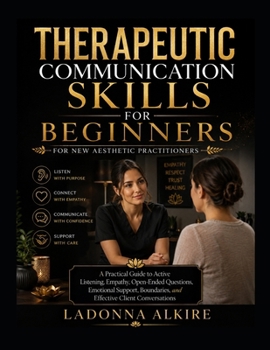
THERAPEUTIC COMMUNICATION SKILLS FOR BEGINNERS: A Practical Guide to Active Listening, Empathy, Open-Ended Questions, Emotional Support, Boundaries, and Effective Client Conversations

Build confidence. Listen with purpose. Communicate with greater empathy and clarity.
Effective communication is at the heart of every helping relationship. Whether you are beginning your journey in counseling, social work, caregiving, coaching, healthcare, education, or another people-focused field, knowing what to say-and how to listen-can make a meaningful difference.
Therapeutic Communication Skills for Beginners is a practical, accessible introduction to the communication techniques that help create respectful, supportive, and productive conversations. Written with beginners in mind, this book breaks down important concepts into clear explanations and practical examples without overwhelming you with complicated terminology.
Inside, you will explore how to develop active listening skills, ask thoughtful questions, demonstrate empathy, respond appropriately to emotions, and create an environment where people feel heard and respected. You will also discover how verbal and nonverbal communication work together, how tone and body language influence conversations, and how to avoid common communication mistakes that can unintentionally create distance or confusion.
You will learn how to:
Build trust and rapport through effective communication
Practice active and attentive listening
Use open-ended and focused questions effectively
Communicate empathy without judgment
Recognize important nonverbal signals
Respond appropriately to emotions and difficult moments
Use reflection, clarification, summarizing, and paraphrasing
Maintain healthy professional boundaries
Handle challenging conversations with greater confidence
Avoid common communication barriers and misunderstandings
Develop a more patient, respectful, and supportive communication style
Rather than simply giving you theory, this book focuses on practical skills you can understand, practice, and gradually incorporate into everyday interactions. Examples and beginner-friendly guidance make it easier to recognize how therapeutic communication works in real conversations.
You do not need to be an experienced professional to benefit from these skills. If you are a student, aspiring helping professional, caregiver, volunteer, educator, coach, or simply someone who wants to communicate more effectively and compassionately, this guide offers a useful starting point.
Good communication is more than choosing the right words. It involves listening carefully, understanding another person's perspective, responding thoughtfully, and creating space for meaningful conversation.
Start developing the communication skills that can help you become a more confident, attentive, and compassionate communicator-one conversation at a time.
Customer Reviews
ThriftBooks ® and the ThriftBooks ® logo are registered trademarks of Thrift Books Global, LLC
