


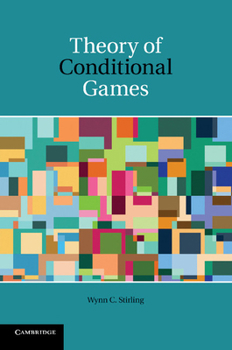
Theory of Conditional Games
No Customer Reviews

Select Format
Select Condition 
Book Overview
Game theory explains how to make good choices when different decision makers have conflicting interests. The classical approach assumes that decision makers are committed to making the best choices for themselves regardless of the effect on others, but such an approach is less appropriate when cooperation, compromise and negotiation are important. This book describes conditional games, a form of game theory that accommodates multiple stakeholder decision-making scenarios where cooperation and negotiation are significant issues and where notions of concordant group behavior are important. Using classical binary preference relations as a point of departure, the book extends the concept of a preference ordering that permits stakeholders to modulate their preferences as functions of the preferences of others. As these conditional preferences propagate through a group of decision makers, they create social bonds that lead to notions of group concordance. This book is intended for all students and researchers of decision theory and game theory.
Format:Paperback
Language:English
ISBN:110742898X
ISBN13:9781107428980
Release Date:July 2014
Publisher:Cambridge University Press
Length:252 Pages
Weight:0.85 lbs.
Dimensions:0.5" x 6.0" x 9.0"
Customer Reviews
0 rating
Copyright © 2026 Thriftbooks.com Terms of Use
| Privacy Policy | Do Not
Sell/Share My Personal Information | Cookie Policy | Cookie Preferences | Accessibility Statement
ThriftBooks® and the ThriftBooks® logo are registered trademarks of Thrift Books Global, LLC
ThriftBooks® and the ThriftBooks® logo are registered trademarks of Thrift Books Global, LLC
